
Table of Content
Contents
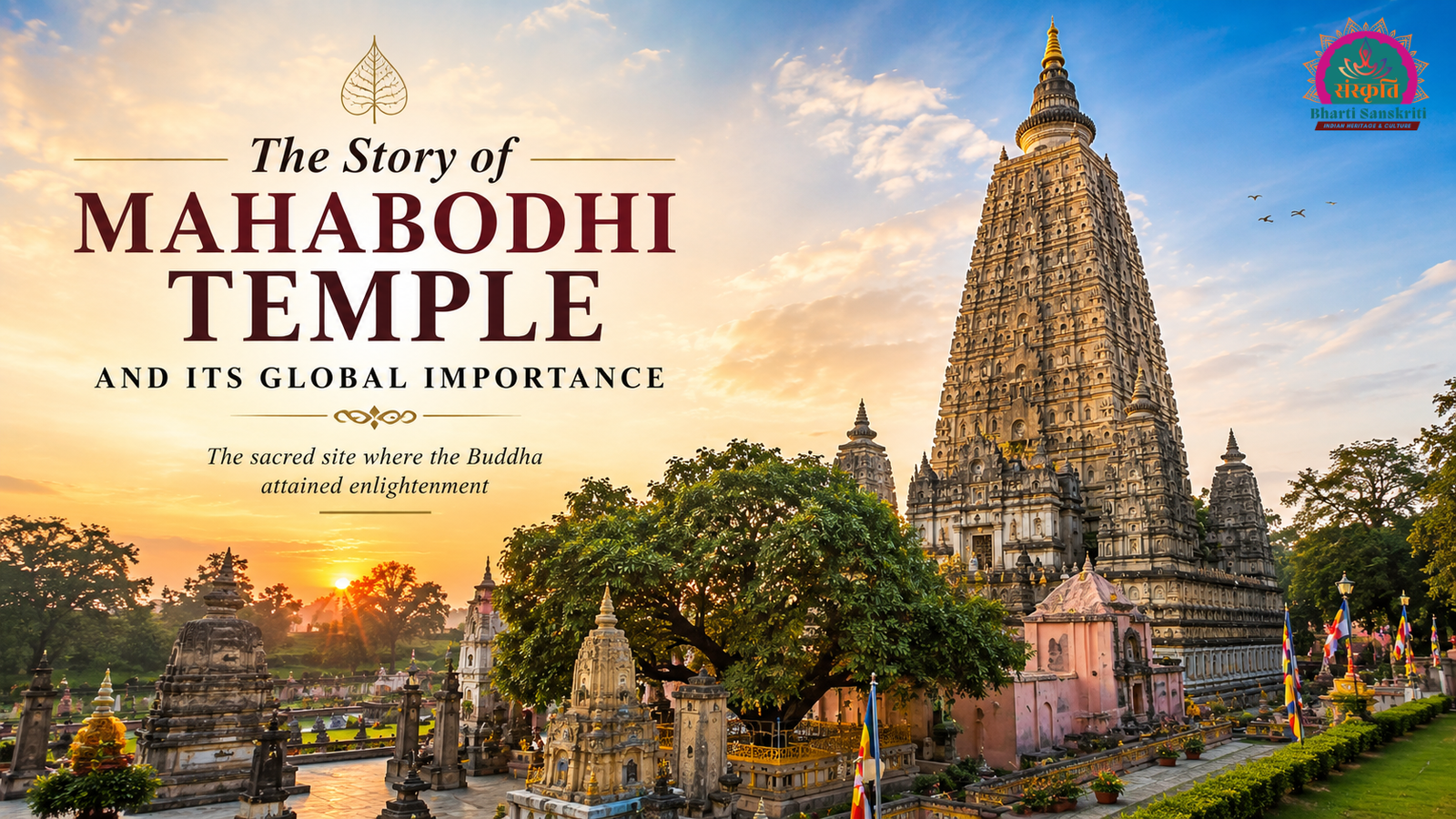
The Mahabodhi Temple, situated at Bodh Gaya in the state of Bihar, India, has been heralded as one of the most prominent Buddhist monuments all over the globe. It is believed that Bodh Gaya is the location where Siddhartha Gautama received enlightenment and thus became known as the Buddha, or “the Awakened One”. So, for all Buddhists over Asia and in other parts of the world, Bodh Gaya is more than an archaeological site, as it is widely connected with the event of Buddha’s life.
The site has historical significance spanning more than 2,000 years. Since the 3rd century BCE, UNESCO states that the first temple built at Bodh Gaya was sponsored by the Emperor Ashoka, although the dominant temple building belongs to the 5th or 6th centuries of our era — that is, to the late Gupta period. The height of the temple is around 50 metres, and the total area of the UNESCO property is 4.86 hectares. The object was included in the World Heritage List in 2002 according to cultural criteria (i), (ii), (iii), (iv), and (vi).
Many reasons make the Mahabodhi Temple very important historically. First, it is closely linked to one of the most historical occurrences in religion. Also, it represents one of the finest forms of early brick architecture in India and holds archaeological proof of centuries of Buddhism. Finally, it still functions as a sacred site that is visited by pilgrims of different Buddhist traditions and beliefs.
The Buddha and the Sacred Landscape of Bodh Gaya
Buddhist tradition holds that Siddhartha Gautama was born a member of an elite family but grew increasingly troubled by the occurrences in the world of mankind, such as growing old, becoming sick, dying, and suffering. He eventually left his former life and undertook a long spiritual search.
Once Siddhartha learnt from teachers and engaged in strict forms of asceticism, he renounced extreme self-denial. According to Buddhist tradition, he then adopted the “Middle Way” between excesses of pleasure and excessive self-denial. This quest eventually led him to the area now known as Bodh Gaya.
Siddhartha meditated under the holy fig tree, presently known as the Bodhi Tree. According to Buddhist lore, it is here that he attained enlightenment and came to understand suffering and how to attain liberation from it. Hence, Bodh Gaya has now become one of the four major pilgrimage sites that are associated with the life of the Buddha- the other three being Lumbini, Sarnath, and Kushinagar. UNESCO also regards Bodh Gaya as the site of the Buddha’s enlightenment.
It is essential to differentiate between religious traditions and the boundaries of historical evidence. The exact date of Buddha’s enlightenment is not confirmed by contemporary records. What can be proved archaeologically is the emergence of Bodh Gaya into a significant Buddhist shrine during the reign of Emperor Ashoka in the 3rd century BCE. According to UNESCO, Ashoka linked himself to the shrine, hence there is early documentary and archaeological evidence of its significance.
The sacred landscape is larger than the main temple itself. UNESCO identifies the Vajrasana, the Bodhi Tree, and six other sacred locations associated with the Buddha’s enlightenment within the complex. Numerous votive stupas and other remains demonstrate the continuing development of the site as a place of worship.
Ashoka and the Early History of the Temple
The first significant historical phase in the development of the Mahabodhi site dates to Emperor Ashoka of the Mauryan Empire. Ashoka governed most of the Indian subcontinent during the 3rd century BCE and became a great supporter of Buddhism.
According to the data gathered by the World Heritage organization, the earliest temple in this area was built by Ashoka around 300 B.C.E. UNESCO mentions the date of 260 B.C.E. as the time when Ashoka was said to visit the place. Besides, the name Ashoka is connected with the construction of the so-called “Diamond Throne” or “Vajrasana,” as well as with the first architectural constructions, such as balustrades and a memorial were created at this site.
Vajrasana is important from religious and archaeological perspectives because it is regarded as the holy seat, linked with the enlightenment of Buddha. According to the Government of India’s Buddhist tourism literature, Vajrasana is described as the stone seat related to the enlightenment attained by Buddha.
The Ashokan phase is of great importance because it proves that Bodh Gaya had already turned into a site of organized Buddhist commemoration long before the temple above was built. Thus, the contemporary Mahabodhi Temple must be regarded as the last major expression of a holy landscape which started its institutional history much earlier.
The Present Mahabodhi Temple
The current Mahabodhi Temple was constructed much later than the original temple built by Ashoka. According to UNESCO, the main surviving structure of the temple was built in the 5th to 6th century CE during the late Gupta period. It is considered one of the earliest surviving Buddhist temples built entirely of bricks in India.
About 50 meters in height, the temple is the most prominent structure in the surroundings. Its central tower rises higher than the other structures in the sacred area and provides identification to this monument. This structure is recognized by UNESCO as one of the key examples of architecture of fully developed brick temples in India.
The importance of the temple is not limited to the fact that it is tall or old. Its design, adornments, masonry, stone railings, and sculptures prove the artistic and technical achievements of that time. According to UNESCO, the stone railings are examples of early sculptural recreations.
The complex also has various votive stupas, constructed at different times by emperors, aristocrats, and common temple-goers. The difference in sizes and shapes illustrates the long pilgrimage history and the Buddhist support of Bodh Gaya.
The Bodhi Tree and Vajrasana
The area behind the main temple, which includes the Bodhi Tree, is considered to be the holiest place by a number of travelers. The Buddhist below contends that this very tree is the same one where Siddhartha received enlightenment.
We need to make it clear that the current tree cannot be regarded simply as the original tree that has not changed. Trees which part of the Bodhi tradition have sustained damage, been replaced or propagated through centuries. The tourism material published by the Government of India indicates that the Bodhi tree in Bodh Gaya has been through number of cycles of transplanting and the current tree is linked to long history of the sacred tree.
This distinction is important for an authentic historical account. The religious significance of the tree rests on a continuous tradition connecting successive trees to the original sacred location rather than on the claim that the physical tree has survived unchanged for more than two thousand years.
The Bodhi Tree holds Vajrasana under its branches. The tree itself and the God of the throne could be called the spiritual heart of the site. It is easy to see why the temple in itself cannot be interpreted only as an architectural structure: the landscape is essential to the success of understanding the religious meaning of Bodh Gaya.
Bodh Gaya Through the Medieval and Modern Periods
The past of the Mahabodhi Temple has not been a tale of thriving victories. UNESCO mentions that the temple experienced a long period of neglect that began in the 13th century and lasted until the 18th century, as well as renovation being made to it in the 19th century, and further conservation efforts in the second half of the 20th century. Despite all these changes, the impressive architectural design of the temple was preserved well enough for UNESCO to declare it as authentic and of great value to humanity.
The recent past of the temple is complicated. As per academic studies, the revival of Bodh Gaya in the nineteenth century involved British archaeologists, Hindu mahants affiliated with the temple, and Burmese Buddhists who aimed at promoting the place. Research by historian Alan Trevithick illustrates the existence of competing interests between 1811 and 1877, which shows that the present-day history of the temple cannot be told in terms of archaeological restoration alone.
The revival of the Buddhist movement in the international domain took place in the late 1800s and had its centre of action in the town of Bodh Gaya, India. Research published by Cambridge University Press interprets the development of transnational Buddhist networks as one of the salient causes of revival in pilgrimage tourism. It was the aforementioned networks that also helped in setting up numerous international Buddhist monasteries or institutions in Bodh Gaya.
This modern revival transformed Bodh Gaya from a relatively neglected sacred site into an international centre of Buddhist pilgrimage and cultural exchange.
A Global Pilgrimage Centre
Today, the Mahabodhi Temple is a living religious site visited by Buddhists from many parts of the world. UNESCO explicitly notes the continuous presence of pilgrims who come to offer prayers, conduct religious ceremonies, and meditate.
One of the distinguishing features of Bodh Gaya is its international character. Virtually all Asian traditions of Buddhism—Theravada, Mahayana, and Vajrayana—have ties with Bodh Gaya. Pilgrims may practice a different form of ritual as well as use different languages, but they possess an understanding that Bodh Gaya is closely tied to the Enlightenment of the Buddha.
What has emerged is a religious landscape that blends Indian tradition with the influence of world Buddhist culture. In and around Bodh Gaya, there are many monasteries and institutions from numerous countries, which makes the area an important place for international Buddhist pilgrimages. Research also indicates that these places can be considered as important elements of the modern rebirth of Bodh Gaya as a global pilgrimage destination.
However, the attraction also brings non-Buddhist pilgrims to the area, such as historians, archaeologists, architecture students, researchers, and even cultural tourists. Hence, the site is significant not only for religious reasons but also in relation to religion, art, architecture, archaeology, and cultural history studies.
UNESCO World Heritage Status
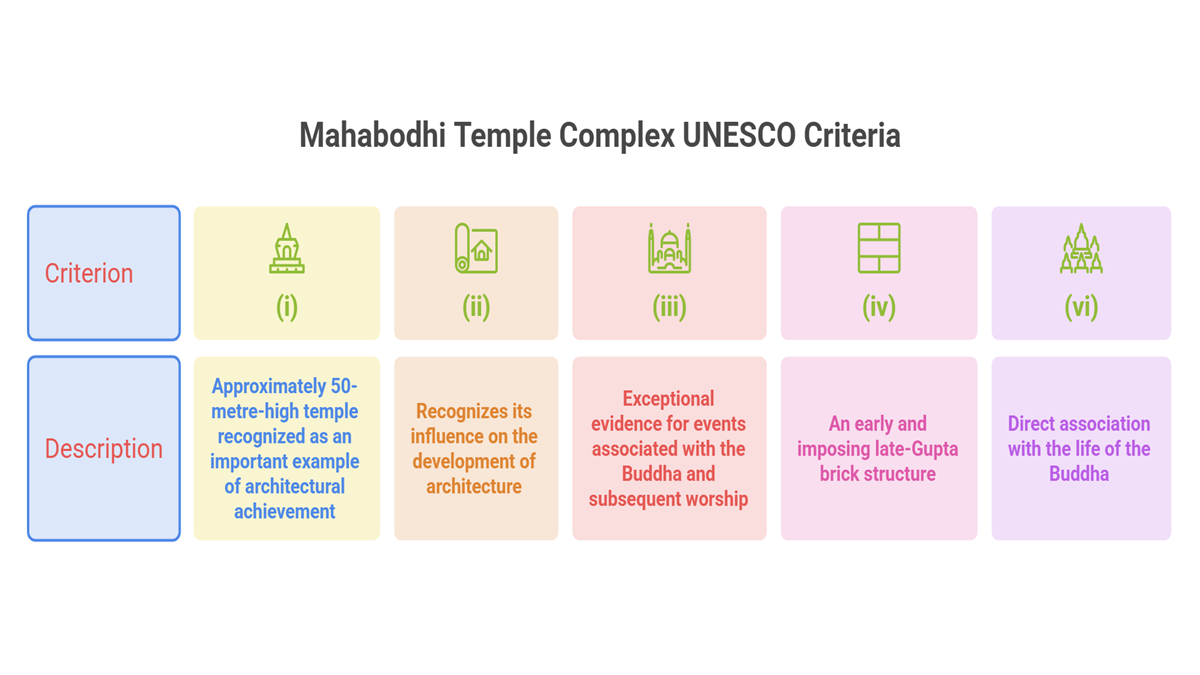
In 2002, UNESCO added the Mahabodhi Temple Complex to its World Heritage List as a result of the decision made by the World Heritage Committee at its 26th session in Budapest. The property has been inscribed under the cultural criteria (i), (ii), (iii), (iv), and (vi).
UNESCO’s recognition rests on several specific qualities. Under criterion (i), the approximately 50-metre-high temple is recognized as an important example of architectural achievement. Criterion (ii) recognizes its influence on the development of architecture. Criterion (iii) emphasizes the site’s exceptional evidence for events associated with the Buddha and subsequent worship. Criterion (iv) highlights the temple as an early and imposing late-Gupta brick structure, while Criterion (vi) recognizes its direct association with the life of the Buddha.
The World Heritage property covers 4.86 hectares and is located at approximately 24°41′43″N, 84°59′38″E.
UNESCO’s choice has also acknowledged the necessity of preserving the religious and spiritual nature of this location. In 2002, the World Heritage Committee publicly addressed its worries about increasing tourism and pilgrimage activities and requested the employment of an overall management technique for the preservation of the site’s characteristics.
Global Cultural and Spiritual Importance
The global importance of the Mahabodhi Temple cannot be explained by architecture alone. Its deepest significance comes from the ideas associated with the Buddha’s enlightenment.
For over two thousand years, Buddhist doctrines surrounding the themes of suffering, compassion, moral behavior, meditation, and wisdom have had an impact on various civilizations throughout Asia. Bodh Gaya exists as a physical landmark of this great culture of thought and belief.
The global significance of the location also illustrates the spread of ideas over the ages. Buddhist thought had its origins in India, but it evolved into different varieties in Sri Lanka, Southeast Asia, Central Asia, East Asia, and the Himalayas. Bodh Gaya has remained a central point for all these various forms of Buddhism.
In this connection, the Mahabodhi Temple shows a type of cultural interconnection that predated the contemporary concepts of globalization and international travel by centuries. Pilgrims, monks, intellectuals, sovereigns, and painters propagated their religions, scriptures, artistic styles, and cultures all over Asia, while Bodh Gaya was one of the leading places of this cultural web.
Conservation and Contemporary Challenges
The ongoing religious use of the site makes it a source of strength and a challenge for preservation. Instead of being just a deserted archaeological site, the temple is frequented by pilgrims who pray, contemplate, give offerings, and engage in worship services.
The historic buildings and the environment surrounding them can come under pressure from tourism and pilgrimage activities. One concern of UNESCO at the time of the listing of the property was the pressure exerted by tourism and pilgrimage, which was followed by the issue of management and conservation being raised by the organization.
The Government of India also continues to support tourism infrastructure in Bihar. In a 2023 parliamentary response, the Ministry of Tourism stated that development of tourism is primarily the responsibility of the state government, while the central ministry provides financial assistance for tourism infrastructure under schemes including Swadesh Darshan and PRASHAD.
Hence, the main challenge in terms of conservation is to strike the right balance. On the one hand, the site should be available to believers, but on the other, the historical texture, architectural features, and sacred area should be kept safe and sound. On the contrary, over-commercialization or uncontrolled construction might create problems for the heritage values of the site. At the same time, it is important to make sure that the role of the site as a religious place is preserved.
Read More Articles👉: Valley of Flowers National Park, Shilpa Shastra, 10 Hidden Places in India
Mahabodhi Temple and India’s World Heritage
Mahabodhi Temple shows how much India contributes to civilization globally. The temple stands as a symbol for one of the great religious and philosophical traditions of the world and is an epitome of the advanced architecture of ancient India.
Its importance to India is strengthened by its international connections. Visitors from numerous countries come to Bihar because Bodh Gaya is central to their religious history. The presence of international Buddhist institutions around the site further demonstrates the continuing cultural relationship between India and Buddhist communities across Asia.
The temple therefore belongs simultaneously to several overlapping worlds: it is a monument of Indian history, a Buddhist sacred site, an archaeological resource, an architectural landmark, and a global heritage property.





Subscribe to Our YouTube Channel: https://www.youtube.com/@BhartiSanskriti-BS