

Table of Content
Contents
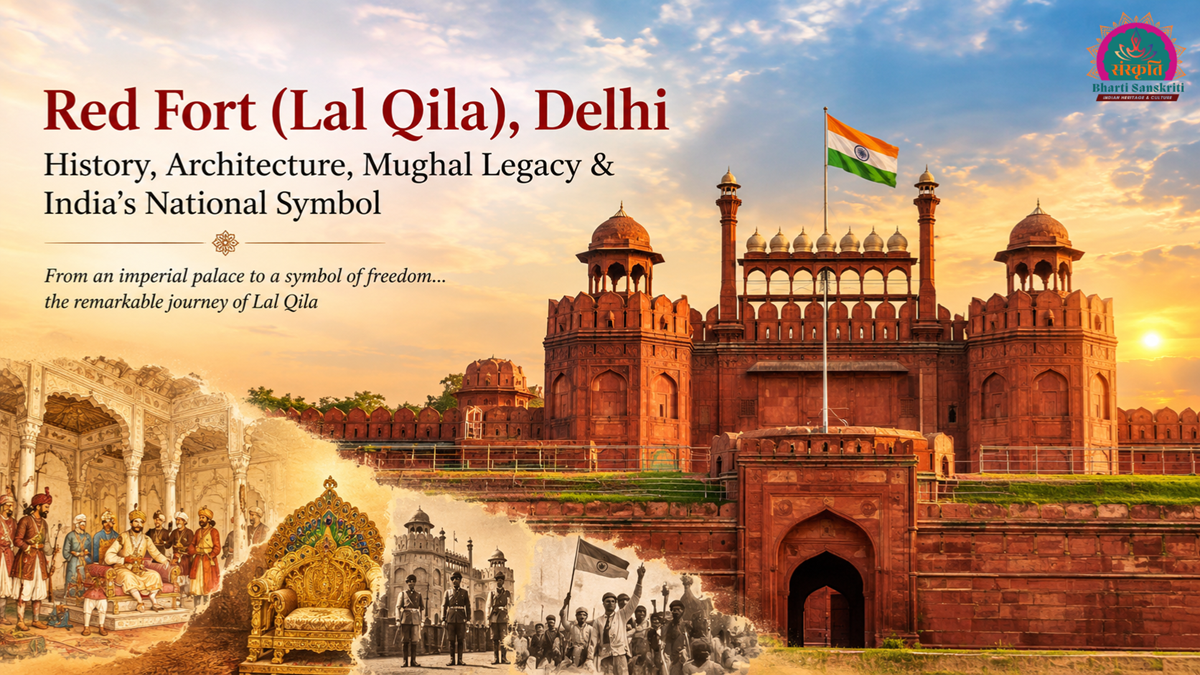
Very few sites in India possess as rich a history as the Red Fort or Lal Qila in Delhi. The grand red sandstone walls of this monument have borne testimony to the glory of the Mughal court, the ruin of an empire, the events of 1857, and the British military rule, before ultimately witnessing the establishment of an independent India.
The Red Fort is not only the site of Independence Day celebrations and the Prime Minister’s Address on 15 August every year, but it holds much greater significance than this annual event. The Red Fort was built in the 17th century as the fort-palace of Shahjahanabad, which became the new Imperial Capital of all India, founded by Mughal Emperor Shah Jahan. The architecture of the Fort was a unique amalgamation of different cultural traditions, including Persian, Timurid, Islamic, and Indian. This is why UNESCO considers the Red Fort Complex a World Heritage Site.
Today, Lal Qila stands not merely as a monument of the Mughal era, but as a remarkable record of India’s changing history.
Red Fort at a Glance
- Popular name: Lal Qila or Red Fort
- Builder: Mughal Emperor Shah Jahan
- Associated city: Shahjahanabad
- Construction began: 1639
- Major construction completed: 1648
- Primary material: Red sandstone, with extensive marble and decorative work in the palace areas
- Original purpose: Imperial palace-fort and centre of Shah Jahan’s new capital
- UNESCO World Heritage inscription: 2007
- UNESCO criteria: (ii), (iii) and (vi)
The term “Red Fort” is derived from the grand red sandstone walls around the fortress. But within these walls lay an elaborate royal environment that included, among other things, halls for receiving visitors and private residences, as well as gardens and canals, all adorned with decorative pavilions.
Why Did Shah Jahan Build the Red Fort?
The story of the Red Fort is closely connected with Shah Jahan’s decision to establish a new imperial capital in Delhi.
Initially, the center of the Mughal Empire was Agra, but later in the 17th century Shah Jahan moved it to Delhi. He constructed a new city called Shahjahanabad that served as the base of the Mughal rule. In the center of the walled city, the Red Fort was built, which was known as the palace-cum-fort. The palace-fort of Shahjahanabad is described by the United Nations Educational, Scientific and Cultural Organization (UNESCO) as a monument that represents the power of the Mughal emperors and their excellence in architecture.
The commencement of construction took place in April 1639 and was largely completed by 1648. Thus, the task consisted of not just the construction of a defensive building but was part of a wider scheme of building cities and planning an empire. Shahjahanabad was built up around this palace-fort, owing to which the Red Fort became not only the political center of Shahjahanabad but also the home of the emperor.
Originally named Qila-i-Mubarak, which translates to the Blessed Fort, the fort’s design incorporated the Mughal notion of an imperial residence where politics, ceremony, art, nature, and architecture could coexist.
Construction and Design of the Red Fort
The Red Fort was designed to combine the strength expected from a fortified enclosure with the elegance expected from a royal palace.
The huge red sandstone walls gave the exterior a dominant look, while inside it was much more sophisticated. There were marble pavilions, decorations, gardens, and water features inside, which gave the interior a royal and ceremonial feel.
The fort’s connection with the Yamuna was crucial to its natural surroundings because the river played a significant role in the eastern landscape of the fort complex. The river significantly affected how the complex looked and was designed as a whole. However, the urban landscape of Delhi has changed drastically over the years, and so has the fort’s original connection with the Yamuna. UNESCO describes this change as one of the influences on the historical setting of the site.
The Red Fort therefore needs to be understood as both a fortress and a palace—a place where defence and royal luxury were deliberately combined.
Red Fort Architecture: The Height of Mughal Refinement
The architectural importance of the Red Fort lies not simply in its size or appearance but in the sophisticated combination of different traditions.
According to UNESCO, Mughal architecture emerged as a synthesis of the Mughal traditions consisting of Islam, Persia, Timurid, and Hindu traditions. Various ideas, methods, and crafts from different locations were mixed with local craftsmanship to create a unique architectural language which was Mughal in origin but relied heavily on the artistic traditions of Indian culture.
The Red Sandstone Ramparts
The size of the red sandstone walls is certainly one of the most noticeable features of the monument in this case. The grandeur of the structure is suggestive of strength, power, and durability.
But these walls also create an important contrast. Outside, the fort presents the image of a powerful imperial stronghold. Inside, the architecture becomes more delicate, decorative, and luxurious.
This transition from imposing fortification to refined palace is one of the defining characteristics of the monument.
Lahori Gate
The Lahori Gate is the principal ceremonial entrance and one of the most recognisable parts of the Red Fort.
Its relevance has prevailed nowadays beyond architecture. The monument has become closely associated with the national identity of India as it is the venue for the Independence Day speech given by the Prime Minister from the Red Fort complex.
Delhi Gate
The Delhi Gate formed another important entrance to the fortified complex. Together, the major gateways demonstrate how the Red Fort combined practical defensive requirements with monumental architectural design.
Inside the Red Fort: An Imperial Palace
Behind the massive walls was a world designed around the life and ceremony of the Mughal court.
The Red Fort had spaces for the public and private use of royal families, ceremonial areas, gardens, and water management systems. The planning of the fort indicates that an imperial abode had to cater to the needs of the emperor’s family members and departments, diplomats, and dynamic court life.
Chatta Chowk
Near the entrance was Chatta Chowk, a covered marketplace associated with the royal complex.
Its presence demonstrates that the Red Fort was not an isolated palace. It was a functioning imperial environment in which commerce, craftsmanship, courtly life, and ceremonial activity were closely connected.
Naubat Khana
The Naubat Khana, or drum house, played an important ceremonial role. Music and drums were used in royal ceremonies and announcements, reinforcing the highly formal character of Mughal court life.
The architecture of the Red Fort therefore appealed not only to the eye but also to sound, movement and ceremony.
Diwan-i-Aam
The Diwan-i-Aam, or Hall of Public Audience, was where the emperor could appear before subjects and hear petitions.
Its function reflected an important aspect of Mughal kingship: the emperor was not only a distant ruler but also the visible centre of an elaborate system of administration and justice.
The hall’s architecture reinforced this hierarchy, placing the emperor in a position from which imperial authority could be both seen and experienced.
Diwan-i-Khas
In contrast, the Diwan-i-Khas, or Hall of Private Audience, was associated with more exclusive meetings involving nobles, officials, and distinguished visitors.
The grand marble craftsmanship demonstrates the lavish aspect of Shah Jahan’s architectural dreams. Being known as an emblem of the extravagant wealth and ceremony of the Mughal court, this hall has become one of the best-known places in the fort.
Nahr-i-Behisht: The Stream of Paradise
Among the most remarkable features of the Red Fort was its sophisticated use of water.
The private apartments of the palace were interlinked by an uninterrupted waterway called the Nahr-i-Behisht, which translates to “Stream of Paradise.” UNESCO recognizes this waterway as a significant part of the architecture of a palace.
Water in Mughal architecture had a practical application but also possessed strong symbolism. Water features, gardens and puce constructions gave a feeling of paradise and created the atmosphere of freshness and purity in royal surroundings.
The Nahr-i-Behisht therefore demonstrates how Mughal architecture brought together engineering, aesthetics and symbolism.
Rang Mahal, Mumtaz Mahal and the Royal Apartments
The Red Fort’s private quarters reveal another side of Mughal court culture.
The Rang Mahal, meaning ‘the Palace of Colours’, was connected with the areas of royal habitation and was popular for its adorned interiors. Another vital component of the palace complex was Mumtaz Mahal.
Comfort, decoration, and ecological aspects were taken in mind while designing these spaces. Marble, decorative patterns, water paths, and well-distributed rooms made the royal room a very different place compared to the defensive look of the external fortifications.
The contrast illustrates an essential principle of Mughal palace architecture: imperial power was expressed not only through walls and weapons, but also through beauty, order, craftsmanship and controlled access.
Mughal Art and Decoration at the Red Fort
The architectural beauty of Lal Qila is inseparable from its decorative arts.
Its interiors incorporated carved marble, floral designs, ornamental work, calligraphy, delicate screens, and pietra dura techniques. Persian-inspired motifs existed alongside Indian craftsmanship, producing a distinctive decorative vocabulary.
The architectural phase of Shah Jahan is notably marked by the lavish utilization of marble, beautiful floral decorations, and pietra dura. All of these factors created an air of luxury that became typical for the mature Mughal aesthetic.
The Red Fort consequently represents more than monumental construction. It also preserves evidence of the highly skilled artisans, designers and craftsmen who worked within the Mughal cultural world.
The Red Fort and the Peacock Throne
The splendour of Shah Jahan’s court is often associated with the legendary Peacock Throne.
The throne transformed itself into a highly significant symbol of Mughal power and royal authority. Connected with the Diwan-i-Khas, it epitomizes the intensive ceremonial culture that developed at the Mughal court.
The fact that it was later removed from Delhi also symbolizes the political decline of the Mughal Empire. Hence, the story of the throne can be treated as a part of a bigger transition from the peak of the Mughal Empire to political fragmentation and invasions from outside forces.
The Red Fort and the Decline of Mughal Power
The Red Fort’s history did not remain frozen in the age of Shah Jahan.
As the power of the Mughal Empire declined, the meaning of the imperial complex also changed. The political turmoil, power struggles, and invasions affected the situation at the court. In 1739, Nadir Shah of Persia invaded Delhi and looted the treasury of the Mughals. Historical sources describe the effects of this event on the Red Fort as well as the imperial court.
The fort gradually ceased to represent the unquestioned power of a dominant empire. Instead, it became a witness to the long political decline of Mughal authority.
The Red Fort and the Revolt of 1857
One of the most dramatic chapters in the history of Lal Qila came in 1857.
At this time, Bahadur Shah Zafar, the Mughal emperor, had little true political power, although he had great symbolic significance in this situation. It was about the events of 1857 when Delhi and the Red Fort were considered to be the place from which the fight against the British was carried on.
The events that followed transformed the history of the monument.
After the British recaptured Delhi, Bahadur Shah Zafar was arrested and subsequently tried. The Mughal political order that had survived in increasingly symbolic form finally came to an end.
The Red Fort, once the centre of Mughal imperial authority, now entered a completely different phase.
The Red Fort Under British Rule
After the Revolt of 1857, the British took control of the Red Fort and converted it into a major military establishment.
The changes brought about by this transformation have left a significant impression on the original Mughal palace complex. The existing buildings had been destroyed or changed, and military structures have been added to the medieval landscape. The Red Fort Complex bears witness to the British military occupation, which is regarded as an important layer in the history of this architectural monument by UNESCO.
The change was more than architectural. The symbolic identity of the fort also changed—from the centre of Mughal sovereignty to a British-controlled military space.
This period reminds us that heritage monuments are not always preserved unchanged. They can accumulate layers of history, including periods of destruction, adaptation and reuse.
Red Fort and India’s Freedom Struggle
As India’s independence movement gathered strength, the Red Fort acquired another powerful historical association.
After World War II, this military outpost also became a venue for the famous trials of the Indian National Army members. The trials were of great public concern and helped garner more political significance in the political scenario of the end of British imperial rule.
The monument that had once represented Mughal sovereignty was now becoming associated with the struggle to end colonial rule.
This transformation is central to understanding why the Red Fort occupies such a powerful place in India’s modern historical imagination.
Why Does the Prime Minister Hoist the National Flag at the Red Fort?
The Red Fort’s strongest modern association began with India’s independence in 1947.
On 15 August 1947, India celebrated its independence from British rule, and the Red Fort became the setting for this historic transition. Since then, it has developed into the country’s most recognisable Independence Day venue.
Every year, the Prime Minister hoists the national flag and addresses the nation from the Red Fort.
The symbolism is profound. A monument once built to represent Mughal imperial authority became a national stage for a democratic republic.
UNESCO itself identifies the Red Fort’s association with India’s independence as a central element of its Outstanding Universal Value.
Red Fort as a Symbol of Independent India
The history of Lal Qila can therefore be understood through three major identities.
First, it was a Mughal palace-fort:
a representation of Shah Jahan’s imperial power and the extraordinary artistic achievements of Mughal India.
Second, it became a witness to colonial transformation:
The decline of the Mughal Empire, the events of 1857, and the British military occupation fundamentally changed its role.
Third, it became a symbol of independent India:
The same monument that once represented imperial sovereignty became the setting for the celebration of national freedom.
Few monuments demonstrate such a dramatic transformation of historical meaning.
Why Is the Red Fort a UNESCO World Heritage Site?
The Red Fort Complex was inscribed on the UNESCO World Heritage List in 2007 under criteria (ii), (iii) and (vi).
Its importance rests on several interconnected qualities.
Under Criterion (ii), the fort demonstrates an exceptional fusion of architectural traditions, bringing together Islamic, Persian, Timurid and Hindu influences.
Under Criterion (iii), its innovative planning, architectural elements, and garden design influenced later buildings and gardens across northern India and beyond.
Under Criterion (vi), the Red Fort is directly associated with major events that shaped the region’s history and identity, particularly the transition from Mughal rule through British rule to independent India.
Thus, UNESCO recognition is not based simply on the age or beauty of the monument. It reflects the Red Fort’s architectural innovation, cultural exchange, and historical significance.
Red Fort: A Fusion of Cultures
One of the most valuable lessons offered by the Red Fort is that architecture rarely develops in isolation.
Its foundations belong to the Mughal architectural tradition, but that tradition itself absorbed influences from different regions and cultures.
Persian influences can be seen in aesthetic concepts, decorative traditions, and aspects of palace planning.
Timurid traditions connect Mughal architecture with the Central Asian heritage from which the Mughal dynasty emerged.
Islamic architectural principles influenced spatial planning, geometry and the design of important palace structures.
At the same time, Indian craftsmanship and architectural traditions were incorporated into the complex.
UNESCO therefore describes the Red Fort as a particularly refined fusion of Islamic, Persian, Timurid and Hindu traditions.
This synthesis is one reason why Lal Qila occupies such an important position in the history of Indian architecture.
From Mughal Palace to National Symbol
The complete history of the Red Fort can be understood as a remarkable journey.
- 1639–1648: Shah Jahan creates an imperial palace-fort at the heart of Shahjahanabad.
- Mughal period: The fort becomes a centre of imperial administration, courtly culture, art and architecture.
- 18th century: Political instability and invasions weaken Mughal power.
- 1857: The Red Fort becomes closely associated with the final chapter of Mughal political authority.
- British period: The palace-fort is transformed into a military establishment.
- 1947: The monument acquires a new meaning as a symbol of India’s independence.
- Today: Lal Qila represents India’s layered cultural heritage and continues to serve as one of the country’s most important national symbols.
Why Red Fort Still Matters Today
The Red Fort matters because it allows us to see India’s history as a continuous and changing story.
The red sandstone walls signify the Mughal glory. The marble halls indicate the culture of the royal court. The modified rooms indicate the colonial changes. To connect it with the independence movement links to the journey of India toward liberation. To be part of the Independence Day observations connects the 17th-century edifices with the idea of India as a country.
The Red Fort is therefore not simply a monument belonging to one dynasty or one period.
It is a layered historical document in stone.
The importance of this place is based on the great realms that have unfolded within its walls: Shah Jahan’s royal court, the disintegrating Mughal dynasty, the period of British colonialism, and the India that was born in 1947 as an independent state.
Explore More Articles👉: The National Emblem of India, The Real Story Behind the Iron Pillar, Bihari Cuisines…e.t.c.
Conclusion
The story of the Red Fort is ultimately a story about the changing meaning of power.
Shah Jahan constructed it as the beautiful core of Shahjahanabad, a castle-palace created to show the greatness of the Mughal Empire. Its architecture combined many different artistic styles and was one of the best results of Mughal planning and craftsmanship.
However, history changed the meaning of the Red Fort. The Red Fort was a witness to the loss of Mughal power, the revolt of 1857, and the subsequent advent of British military rule. Many years later, the same monument turned into a symbol of freedom when India started its life as a free country.
That transformation is what makes Lal Qila extraordinary.
The fortifications are not just monuments of aesthetically pleasing architecture. They also hold within them the memories of empires, cultural exchanges, political transformations, and revolts. Today, whenever the Indian flag is hoisted on the Red Fort on Independence Day, it gives a new identity to the history of the fort.
The Red Fort, from Qila-i-Mubarak, which was the magnificent palace of Shah Jahan, to Lal Qila, the most esteemed national symbol of independent India, serves as a constant reminder that heritage is not solely about guarding what is of yore.





Subscribe to our Youtube Channel: https://www.youtube.com/@BhartiSanskriti-BS