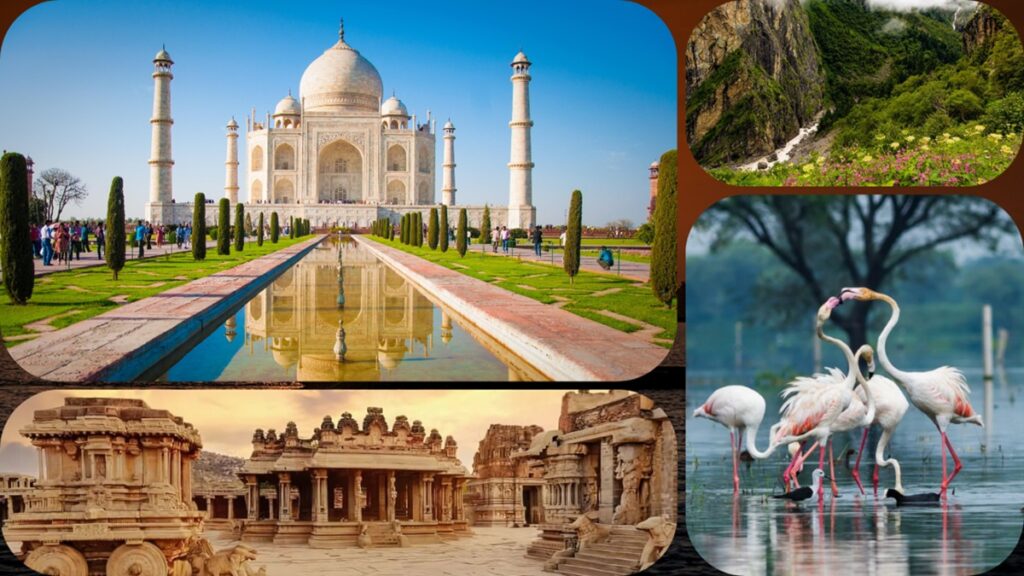


India’s spiritual culture is closely tied to the worship of Lord Shiva, one of the major gods of Hinduism. Many temples throughout India are dedicated to Shiva, but twelve hold greater religious significance than others. These temples, known as the 12 Jyotirlingas in India, contain unique versions of Shiva’s infinite divine presence. For hundreds of years, devotees, pilgrims, and other people have come to these temples to achieve their spiritual desires.
Situated between the snow-capped peaks of Uttarakhand’s Himalayan region and the divine beaches of Tamil Nadu, every Jyotirlinga has its own significance influenced by legends, traditions of the area, architecture, and history. A few of them are connected to ancient cities and holy rivers, while others are found amidst forests, mountains, and along the seashore. All twelve temples show the essence of Lord Shiva as well as the immeasurable diversity of India’s geography and culture.
In this article, we explore the names, locations, religious significance, and fascinating legends of all 12 Jyotirlingas, along with useful information for anyone interested in understanding or visiting these sacred temples.
What Is a Jyotirlinga? Meaning and Spiritual Significance
The term “Jyotirlinga” is formulated by combining two Sanskrit words: “Jyoti” (which translates into “light,” “brightness,” or “illumination”) and “Linga” (which is referred to as the sacred symbol for Lord Shiva). This means that Jyotirlinga is a radiant manifestation of Shiva, i.e., it reveals the infinity, timelessness, and formlessness of Shiva. The main difference between Jyotirlinga and any other representation of the deity is in the fact that Jyotirlinga is seen as a special manifestation of divine energy in the practice of Hinduism.
According to a famous legend associated with the Shiva Purana, Lord Brahma and Lord Vishnu once disputed who was supreme. Shiva appeared before them as an enormous pillar of light extending endlessly in both directions. Brahma and Vishnu attempted to discover its limits but could not find either its beginning or its end. The story symbolizes Shiva’s boundless nature, which transcends ordinary human understanding. The twelve Jyotirlingas are traditionally associated with this concept of infinite divine light.
Believers think that worshipping at these shrines grants them blessings, peace of mind, purity, and spiritual emancipation (moksha). In addition, their significance in the Dwadasha Jyotirlinga Stotram, a prominent prayer that venerates all twelve sacred forms of Lord Shiva, can be witnessed.
Complete List of 12 Jyotirlingas in India (Jyotirlinga Temple)
The following table provides the commonly followed list of the twelve Jyotirlinga names and their geographical locations.
| No. | Jyotirlinga Temple Name | Location | State |
| 1 | Somnath | Prabhas Patan, Gir Somnath | Gujarat |
| 2 | Mallikarjuna | Srisailam | Andhra Pradesh |
| 3 | Mahakaleshwar | Ujjain | Madhya Pradesh |
| 4 | Omkareshwar | Mandhata Island | Madhya Pradesh |
| 5 | Kedarnath | Rudraprayag district | Uttarakhand |
| 6 | Bhimashankar | Pune district | Maharashtra |
| 7 | Kashi Vishwanath | Varanasi | Uttar Pradesh |
| 8 | Trimbakeshwar | Trimbak, Nashik district | Maharashtra |
| 9 | Vaidyanath (Baidyanath) | Deoghar | Jharkhand |
| 10 | Nageshwar | Near Dwarka | Gujarat |
| 11 | Rameshwaram | Rameswaram Island | Tamil Nadu |
| 12 | Grishneshwar | Verul, near Ellora | Maharashtra |
The sequence is based on a well-established tradition of pilgrimage. The actual identification of the Jyotirlingas, on the other hand, is not the same in all the religious texts and regional customs. For instance, Vaidyanath is referred to in both Deoghar in Jharkhand and Parli Vaijnath in Maharashtra, while Nageshwar is linked with Aundha Nagnath in Maharashtra.
12 Jyotirlingas in India and Their Religious Significance
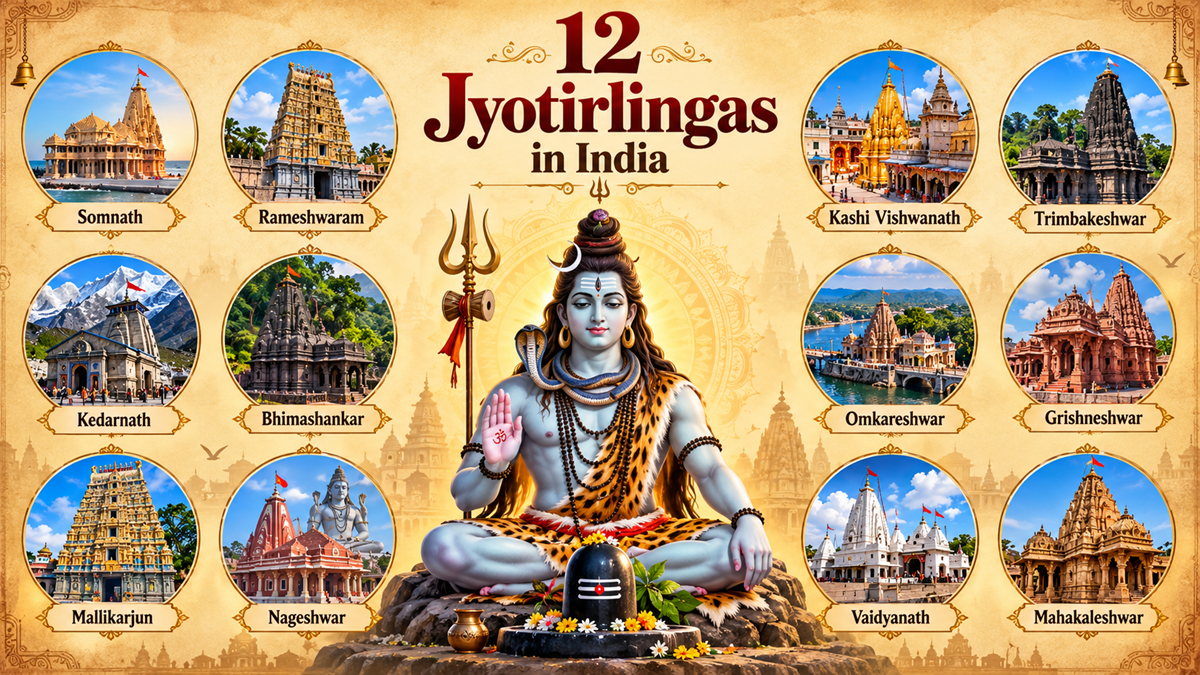
1. Somnath Jyotirlinga – Gujarat
Somnath Temple is situated in Prabhas Patan, Veraval, along the Arabian Sea coast of India in Gujarat. Somnath is widely accepted as the first of all the 12 Jyotirlingas in the country. The name of the temple literally means the “God of the Moon,” which relates to the legend of Chandra. According to Hindu mythology, Chandra was cursed by Daksha after showing greater affection towards one of his wives, Rohini. After that, Chandra prayed to Lord Shiva for the removal of his curse and was granted an astrological blessing that relates to the waxing and waning of the moon.
Somnath also occupies an important place in Indian history because the temple experienced repeated attacks, destruction, and reconstruction across different periods. Its present structure was built after India’s independence, with the reconstruction strongly supported by Sardar Vallabhbhai Patel and K. M. Munshi. The temple was officially inaugurated on 11 May 1951. Today, its magnificent architecture, coastal setting, and historical associations make Somnath an important symbol of religious continuity and India’s cultural heritage.
2. Mallikarjuna Jyotirlinga – Andhra Pradesh
The Mallikarjuna Jyotirlinga is located at Srisailam in the Nallamala Hills of Andhra Pradesh, near the Krishna River. This temple belongs to Lord Shiva, as well as Mallikarjuna, and is one of the most important holy sites in South India, along with others. Among the many tales associated with this temple, one of them is concerning Lord Kartikeya, who was angry because of his brother Ganesha and went to Mount Krauncha. Lord Shiva and Parvati went to comfort Lord Kartikeya, thereby giving a divine relevance to Srisailam.
What sets Mallikarjuna apart is its link with the Jyotirlinga and Shakti Peetha beliefs. While Mallikarjuna is worshipped as a form of Shiva, the goddess Parvati is worshipped as Bhramaramba. As a result of the association of these two beliefs, the temple holds a special significance in different sects of Shaivism and Shaktism. The temple complex is well-known for its gateways, artistic details, and the age-old pilgrimage traditions that continue to attract the worshippers.
3. Mahakaleshwar Jyotirlinga – Madhya Pradesh
Mahakaleshwar Jyotirlinga is located in Ujjain, an age-old city on the banks of the Shipra River, and this temple worships Shiva in his aspect of Mahakala. His original meaning is “the God of Time”. This form of Lord Shiva symbolizes the divine authority existing beyond time, death, and worldly lives. According to a traditional legend, Shiva in Ujjain manifested himself to save his followers from a destructive demon. Thus, this temple was proven to be closely associated with the manifestation of Shiva’s power and protection.
The Mahakaleshwar Temple is noted for its Jyotirlinga, which is directed towards the south, a unique feature compared to other Shiva temples. In addition, the temple is well-known for holding the early-morning ceremony of Bhasma Aarti, which shows the use of holy ash. Apart from its religious significance, Ujjain has been an important center of astronomy, scholarship, and Hindu pilgrimage; hence, the Mahakaleshwar temple is important to the spiritual and academic heritage of India.
4. Omkareshwar Jyotirlinga – Madhya Pradesh
Omkareshwar Jyotirlinga is situated on Mandhata Island in the holy Narmada River in Madhya Pradesh. The island is traditionally linked to the shape of ‘Om (ॐ),’ the Sanskrit symbol, and holds great spiritual significance in Hinduism. Omkareshwar is a Sanskrit word for the ‘Lord of Om,’ associating it with the sacred sound that symbolizes supreme truth. In terms of Hindu mythology, the Vindhya Mountains performed severe penance to make Lord Shiva present here.
Omkareshwar is highly associated with the nearby sacred shrine, the Mamleshwar temple, which is located on the opposite bank of the Narmada River. Therefore, many pilgrims pay the visit to both places during their journey. With its beautiful landscapes formed by hills and rivers, Omkareshwar is a unique combination of nature’s beauty and religion. The location of Omkareshwar, as connected with the Narmada, made it significant on the religious map of central India.
5. Kedarnath Jyotirlinga – Uttarakhand
Situated in the Garhwal region of Uttarakhand, Kedarnath, which is located about 3,583 m above sea level, is considered to be one of the most important Shiva temples in India. It is surrounded by tall mountains covered with snow and located on the bank of the Mandakini River. The temple is traditionally associated with the Pandavas of the Mahabharata. According to legend, after the Kurukshetra War, the Pandavas sought Lord Shiva’s forgiveness for the deaths of gotra hatya (killing their kinsmen) and brahmanahatya (killing teachers and priests) caused during the conflict. Shiva avoided them by assuming the form of a bull, and the story became associated with the five sacred Panch Kedar shrines.
Kedarnath is also an important destination in Uttarakhand’s Char Dham pilgrimage circuit. Its stone architecture, dramatic Himalayan setting, and centuries-old religious traditions make it a remarkable example of India’s mountain temple heritage. Because of heavy snowfall and extreme winter conditions, the temple opens only during a designated pilgrimage season, generally from April or May to October or November.
6. Bhimashankar Jyotirlinga – Maharashtra
Bhimashankar Jyotirlinga is situated in the Sahyadri mountain range in Maharashtra, around 100 km from Pune. The temple is located amid lush green forests and beautiful hills, making it an important pilgrimage site for devotees of Lord Shiva and a favourite destination for nature lovers. Narrated in the Shiva Purana, the legend surrounding the story tells us about Bhima, a strong demon who tormented God’s devotees and acted against God. Lord Shiva eventually fought and defeated the demon, thereby making it a holy place.
The temple is famous for its ancient architectural structure made of stone with elements connected to the architecture of the Nagara style. Bhimashankar Temple is located inside the Bhimashankar Wildlife Sanctuary, which is an ecologically significant area. It plays an important role in preserving biodiversity. The conjunction of spirituality with nature is what makes Bhimashankar unique among the twelve jyotirlingas of the country. Nevertheless, some traditions in the area refer to different places by the name of Bhimashankar.
7. Kashi Vishwanath Jyotirlinga – Uttar Pradesh
The temple of Kashi Vishwanath is located in the ancient city of Varanasi, on the banks of the Ganga River. It is among the most revered Shiva temples of Hinduism. The literal translation of the word Vishwanath means “the Lord of the Universe,” which refers to the ultimate spiritual status of Shiva in the Shaiva traditions. According to Hindu belief, Kashi is a holy city that is closely connected with moksha, or freedom from the repeated cycle of birth and death. Devotees trust that through the worship of Lord Vishwanath and in the holy haven of Kashi, they can find spiritual purification and divine blessings.
The temple has undergone many stages of ruin and rebuilding over the years. The current sacred building was constructed in the 18th century, thanks to the efforts of Queen Ahilyabai Holkar. The characteristic golden towers of the temple appeared and have become the main feature of its architecture. The building of the Kashi Vishwanath Corridor made it possible to connect the temple with the Ganga waterfront easily. Nowadays, the temple serves as a heart of everything religious, cultural, and pilgrimage-related in Varanasi.
8. Trimbakeshwar Jyotirlinga – Maharashtra
The Trimbakeshwar Jyotirlinga is located in Trimbak, which is in close proximity to Nashik in Maharashtra. This area is considered sacred due to the source of the Godavari River. The Godavari River, which is one of the holy rivers in India, was created when Sage Gautama carried out intense penance to please Lord Shiva. Lord Shiva responded to Sage Gautama’s penance by creating the river. This myth connects Trimbakeshwar with Lord Shiva and the Godavari.
Unlike the majority of Jyotirlinga temples, this one is unique in having a three-faced representation that represents three Gods, namely Brahma, Vishnu and Mahesh. The current temple, built with black stone in the 18th century during the Peshwa rule, is best known for its beautiful carvings and architectural features. The temple’s significance as a site of pilgrimage in western India can be understood from its rituals, sacred water sources, and its nearness to the Brahmagiri.
9. Vaidyanath (Baidyanath) Jyotirlinga – Jharkhand
Baba Baidyanath Dham is one of the most renowned places of pilgrimage to Lord Shiva in eastern India, located at Deoghar in the state of Jharkhand. Vaidyanath means “God of the Physicians”. The name is indicative of the healing powers of Shiva. According to the popular story, Ravana did vigorous penance to please Lord Shiva, and as a result of his penance, he got a holy lingam given to him with the instruction that he would not place it on earth till he brought it to Lanka. It is believed that it came to rest there because of other incidents associated with divine activity.
The temple is particularly known for the yearly Shravani Mela wherein hundreds of Kanwariyas bring the holy water of Ganga from Sultanganj in Bihar to perform rituals at Baidyanath Dham. This pilgrimage is a testimony to the religious bonds shared by Bihar and Jharkhand. At the same time, recognition should also be given to Parli Vaijnath temple in Maharashtra, which is also regarded as the Vaidyanath Jyotirlinga as per another recognized tradition.
10. Nageshwar Jyotirlinga – Gujarat
Nageshwar Jyotirlinga, situated near Dwarka in Gujarat, is widely revered as one of the twelve sacred manifestations of Lord Shiva. The name Nageshwar is associated with serpents, which hold symbolic importance in Shiva worship and are often depicted around his neck. According to a legend found in Shaiva religious traditions, a devotee named Supriya was imprisoned by the demon Daruka. Through unwavering devotion and prayers to Shiva, Supriya received divine protection, and Shiva manifested to defeat the forces threatening his devotee.
Known for its huge Lord Shiva statue, the temple draws in lots of visitors to Dwarka as well as nearby pilgrimage sites. It is believed to have spiritual benefits such as shielding from fear and negative forces. However, the identity of Nageshwar Jyotirlinga is disputed among local traditions, some of which propose Aundha Nagnath in Maharashtra as another well-known candidate.
11. Rameshwaram Jyotirlinga – Tamil Nadu
The Rameshwaram Jyotirlinga is located at the Ramanathaswamy Temple on Rameswaram Island in Tamil Nadu, which is situated near the southeastern coast of India. The shrine is of great significance due to its link with Lord Rama and the Hindu epic of Ramayana. According to Hindu belief, Rama performed puja to Lord Shiva at this site on his route to Lanka. As a result, the temple acts as a bridge between the two religious traditions of Shaivism and Vaishnavism.
The Ramanathaswamy Temple is recognized for its impressive corridors, large gopurams, carved pillars, and sacred water areas. Pilgrims usually bathe in one of the holy waters before praying. Rameshwaram is also part of the Char Dham pilgrimage tourism, which is composed of 4 important places of worship, the others being Badrinath, Dwarka, and Puri. Its greatness in architecture and religion is significant to the region of South India.
12. Grishneshwar Jyotirlinga – Maharashtra
Grishneshwar Jyotirlinga is located at Verul, closely situated to the popular Ellora caves in Maharashtra. It is popularly regarded as the twelfth Jyotirlinga temple in the list of Jyotirlingas that is often followed by devotees during pilgrimage. It is remembered and visited because of a heartfelt tale of devotion. Legend has it that a woman named Ghushma devotedly prayed to Lord Shiva despite undergoing all kinds of suffering. Lord Shiva was pleased with her commitment and made an appearance before her, after which the temple got its name.
Queen Ahilyabai Holkar is one of the key patrons responsible for the present temple. There are several sites that she funded for restoration and construction, which are important Hindu religious sites. Grishneshwar Temple is famous for its red-stone design and beautifully carved pillars, along with traditional decorative features. The temple is located close to the UNESCO World Heritage Site of Ellora, and this is of great interest to tourists visiting India’s religious architecture and culture.
Spiritual Significance of the 12 Jyotirlingas in Hinduism
The twelve Jyotirlingas stand as symbols of Lord Shiva’s infinite divine presence and have established significant places in Hindu religious tradition. The devotees believe that worshipping these sacred manifestations brings them blessings, spiritual purification, peace, and freedom from suffering. Additionally, Jyotirlingas are also sought in pursuit of moksha, i.e., getting liberated from the cycle of birth and death. Some auspicious occasions for Shiva worship and visit to his shrines are Mahashivratri and the month of Shravan, which is considered a holy month for Hindus.
Apart from the spiritual significance of Jyotirlingas, they are also a proof of India’s geographical and cultural unity. Scattered in mountains, forests, rivers, along the coast, and in old cities, these monuments connect various communities through shared devotional traditions.Their architecture, festivals, rituals, and local legends preserve valuable aspects of India’s living cultural heritage.
Best Time to Visit the 12 Jyotirlingas in India
The right time for visiting the twelve Jyotirlingas is based on where they are located and on the climate. Mostly, the time of the year would be during the months between October and March which provides cooler climates for visiting the temples in places such as Gujarat, Maharashtra, Madhya Pradesh, Uttar Pradesh, Jharkhand, and Tamil Nadu. Nevertheless, it is also observed that festivals and Shravan month attract huge crowds into places during visits.
Because of its high-altitude location in the Himalayas, Kedarnath requires special planning for travel as it is totally inaccessible during the winter months. The temple remains open from around April or May till around October or November depending upon the weather conditions and the annual religious schedule. Pilgrims will need to keep themselves updated with the temple’s announcements, accommodation options, transport arrangements, and travel advisories before embarking on their journey.
Frequently Asked Questions About the 12 Jyotirlingas
1. Which are the 12 Jyotirlingas in India?
The commonly followed list includes Somnath, Mallikarjuna, Mahakaleshwar, Omkareshwar, Kedarnath, Bhimashankar, Kashi Vishwanath, Trimbakeshwar, Vaidyanath, Nageshwar, Rameshwaram, and Grishneshwar.
2. Which is the first Jyotirlinga in India?
Somnath Temple in Gujarat is traditionally regarded as the first Jyotirlinga in the widely followed sacred list. It is associated with the legend of Chandra, the Moon God, and Lord Shiva.
3. Which state has the most Jyotirlingas?
Maharashtra has three Jyotirlingas in the list used in this article: Bhimashankar, Trimbakeshwar, and Grishneshwar. Some regional traditions recognise additional sites within the state.
4. Which is the highest Jyotirlinga in India?
Kedarnath Temple in Uttarakhand, situated approximately 3,583 metres above sea level, is the highest among the twelve commonly recognised Jyotirlingas.
5. Can devotees visit all 12 Jyotirlingas in one pilgrimage?
Yes, devotees can visit all twelve shrines through a carefully planned pilgrimage covering multiple Indian states. However, travel distances, regional weather, and Kedarnath’s seasonal accessibility must be considered.
Explore More Articles: Shilpa Shastra, History of Somnath Temple, The Cultural Significance of Yoga … e.t.c
Conclusion
In India, the 12 Jyotirlingas are considered some of the most important spiritual sites in the Hindu religion, representing Lord Shiva’s timeless presence and pulsating spiritual heritage of the country. Each shrine has its own unique stories, illustrious history, architecture, and significance in the religion. From being situated in the splendid hills of Kedarnath to being surrounded by sea in Somnath and Rameshwaram, the temples depict the diversity of geographical landscape of sacred places in India.
Apart from their significance as sites of pilgrimage, Jyotirlingas embody a history of religious practices, culture, and traditions. For devotees, visiting Jyotirlingas represents a journey of spiritual importance, while for tourists, they provide a chance of experiencing the interrelationship between religions, history, architecture, etc.





subscribe to my youtube channel: https://www.youtube.com/@BhartiSanskriti-BS/shorts