

Table of Content
Contents
When PM Modi finished his five-country diplomatic trip (UAE, Netherlands, Sweden, Norway, and Italy) between May and July of 2026, there was a lot of news about strategic partnerships, trade talks, and international diplomacy. But in addition to all the official business and announcements, there was another story happening that received some coverage: India’s cultural diplomacy.
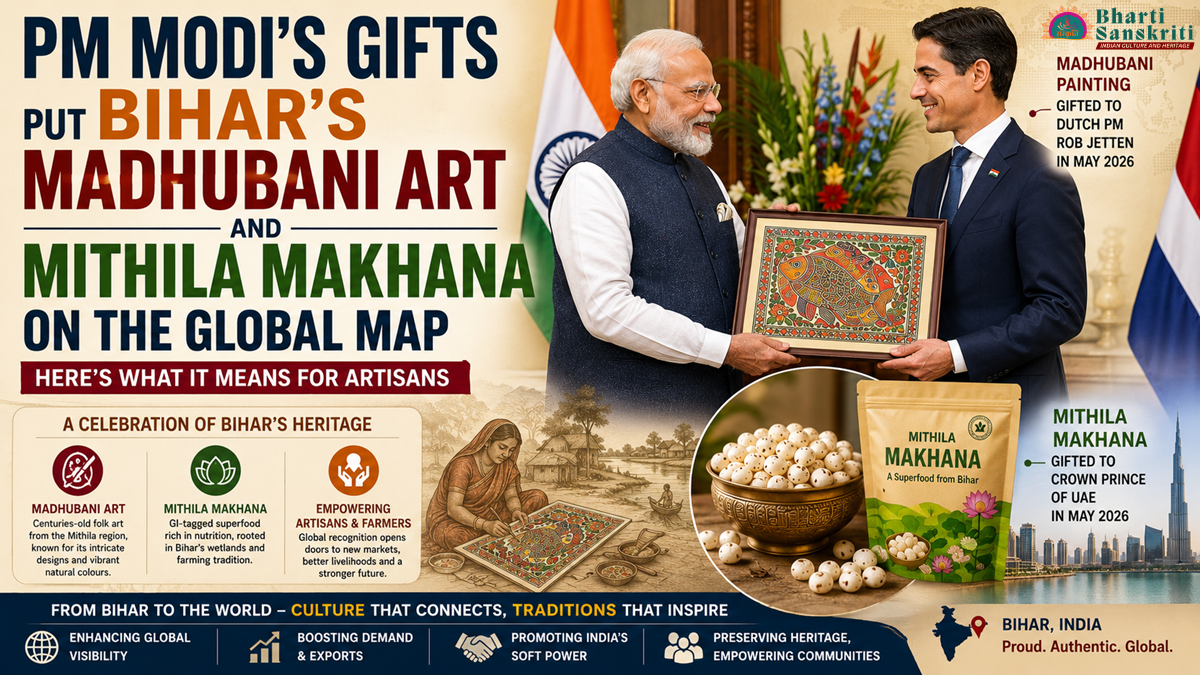
During PM Modi’s tour, he presented custom-tailored gifts to world leaders that represented India’s diverse cultural heritage and artistic abilities through traditional Indian gifts. Among these gifts were two iconic symbols of Bihar: Mithila Makhana and Madhubani art. The gifts were small in nature, but both carry immense symbolic meaning beyond the ceremonial nature they were given for.
In the context of Bihar, such gifts stood for something bigger; the recognition that the world held for its cultural identity, folklore, and indigenous skills. For the artisans and farmers, it meant new hope of getting some attention on the international market front. For India, it meant making culture a more strategic tool of diplomacy.
The moment sparked widespread discussion across Bihar and beyond, raising an important question: can diplomatic recognition translate into real opportunities for local communities?
The Gifts That Drew Global Attention
PM Modi’s overseas trip included gifting several important Indian products and art forms to heads of state around the world. According to sources in the press and from the Indian government, Rob Jetten, Prime Minister of the Netherlands, received a Madhubani painting from the Mithila region in Bihar. The Crown Prince of the UAE received Mithila Makhana (lotus seeds) as part of India’s cultural outreach initiative.
The selection was not random.
India has made extensive use of its traditional handicrafts, textiles, paintings, and GI-tagged products as gift items for diplomatic purposes. This is because they reflect the diversity of the regions, as well as introduce the cultural aspects of India to the foreign diplomats.
The use of Madhubani painting and Mithila Makhana by Bihar in this context was highly significant. Both were representations of centuries-old traditions belonging to the Mithila region of Bihar.
Political leaders and cultural institutions in Bihar saw this as a matter of great pride, arguing that it elevated local traditions onto a global stage.
Madhubani Art: Bihar’s Cultural Ambassador
Few Indian folk art forms enjoy the international recognition that Madhubani painting does.
In the Mithila area of Bihar, India, Madhubani art dates back many generations; it developed steadily through the many different cultural practices and religious traditions of the inhabitants of this area of India. Women typically created elaborate paintings around the homes at festival times, wedding times, or during ceremonial events.
With time, such forms of art have gone through changes where painting on mud walls became painting on handmade paper, cloth, or canvas, allowing people outside the villages to enjoy the art.
Today, Madhubani paintings are known for:
- Vibrant natural colors
- Intricate geometric patterns
- Mythological themes
- Nature-inspired motifs
- Symbolic depictions of animals, birds, and fish
The fish is one of the most frequently seen symbols in Madhubani artwork, representing wealth/abundance, fertility/creativity, harmony/peace, and good luck/positive energy; these culturally associated values and representations can be seen in the depiction of tradition. The fish-themed painting gifted during the diplomatic visit reflected these cultural meanings while presenting a distinctly Indian artistic identity.
For art historians, the Madhubani art form is more than just art. It is a living culture that helps to preserve the regional tales and social traditions of the people.
Its presence in diplomacy can be considered the act of making it a cultural ambassador of Bihar.
How a Village Art Form Reached the World
The journey of Madhubani art from village walls to international galleries is one of India’s most remarkable cultural success stories.
During the 1960’s, cultural institutions and government agencies promoted the transfer of traditional women’s artwork onto paper, resulting in opportunities for new income and preserving an important form of cultural identity.
Soon, exhibitions in India and abroad introduced global audiences to the art form.
Today, Madhubani paintings are displayed in:
- International museums
- Art galleries
- Cultural festivals
- Academic institutions
- Private collections
This art has also been awarded the Geographical Indication (GI) status, thus adding more authenticity to the region.
But despite worldwide recognition, several issues still persist for the creators of the craft. Issues such as poor marketing access, irregular demand, and reliance on middlemen often result in lower remuneration for the artist.
If the painting is presented to any world leader as an official gift, the artwork gains legitimacy, prestige, and visibility that can potentially benefit the larger artisan ecosystem.
Mithila Makhana: Bihar’s Ancient Superfood Goes Global
Though Madhubani painting stands as an illustration of the artistic tradition of Bihar, Mithila Makhana symbolizes the agricultural tradition of the same place.
Makhana is known by various names, such as fox nuts or lotus seeds, and has been grown in the water bodies of Bihar for a very long time.
The Mithila region produces the overwhelming majority of India’s Makhana, making it one of the state’s most distinctive agricultural products.
In recent years, Makhana has gained popularity worldwide due to its nutritional profile. It is rich in:
- Protein
- Fiber
- Calcium
- Antioxidants
Its reputation as a healthy snack has helped it enter urban and international markets.
The product has also received a GI tag, strengthening its branding as an authentic regional specialty.
The gesture of offering Mithila Makhana during diplomatic engagements showed not only the agricultural prowess of Bihar but also its increasing significance in the international health-food market.
Once found nearly exclusively in the area, the product is now being used both as gifts and as symbols of India’s rich history and agricultural achievements.
The Growing Role of Cultural Diplomacy
Diplomatic gifts have long served as tools of international relations.
Throughout history, nations have exchanged artworks, rare products, textiles, and cultural artifacts to symbolize goodwill and mutual respect.
In contemporary diplomacy, such gifts often communicate messages that formal speeches cannot.
They tell stories about:
- National identity
- Historical traditions
- Cultural pride
- Regional diversity
- Shared values
India’s recent gifting strategy increasingly reflects this philosophy.
Instead of using general ceremonial items, nowadays diplomatic gifts are more about the regional craftsmanship and its culture.
From Assam’s Muga silk to Rajasthan’s Blue Pottery and Bihar’s Madhubani paintings, these selections emphasize the diversity of Indian culture.
This practice helps India build its soft power by presenting unique Indian traditions to the rest of the world.
What Global Recognition Means for Bihar’s Artisans
For artisans in Bihar, the significance of these diplomatic gifts extends beyond symbolism.
Recognition at the highest international level can influence public perception, consumer interest, and market demand.
When an art form receives global exposure, several opportunities emerge:
Increased Demand
The international limelight can cause curiosity in collectors, tourists, and cultural institutions alike.
Those who first come into contact with Madhubani painting via the news reports or diplomatic coverage might be inclined to investigate further and acquire genuine Madhubani artworks.
Better Branding
Association with national diplomacy enhances prestige.
Goods and artworks of art involved in diplomacy gain more brand strength since they are believed to symbolize excellence in the country’s culture.
Export Opportunities
Greater visibility may draw in exporters, galleries, and international buyers who would like to obtain genuine products straight from the hands of artisans.
Tourism Growth
Recognition of regional traditions can also boost cultural tourism.
Folk art enthusiasts could possibly be encouraged to explore the Mithila area of Bihar due to which more job prospects will emerge.
The gift-giving practices of PM Modi have been deemed significant by many local leaders in terms of increasing awareness about Bihar’s cultural and agricultural strengths globally.
Recognition Alone Is Not Enough
Global exposure brings many opportunities, but according to specialists, it should be paired with organizational help.
Many artisans continue to face challenges such as:
- Limited digital access
- Lack of international marketing knowledge
- Inadequate pricing mechanisms
- Dependence on middlemen
- Competition from machine-made imitations
In a similar way, Makhana producers face problems regarding processing, storage, packaging, and transportation.
For international attention to produce lasting benefits, several measures may be necessary:
- Improved artisan training programs
- Better e-commerce integration
- Export promotion initiatives
- Stronger GI protection
- Access to global marketplaces
- Financial support for craft clusters
In case these changes are not introduced, symbolic recognition may not translate into meaningful economic growth.
The challenge lies in converting visibility into sustainable livelihoods.
Bihar’s Cultural Economy Is Gaining Momentum
The focus on Madhubani paintings and Mithila Makhana can be seen as a reflection of the change taking place in Bihar.
Hitherto looked upon as a region with migration, poverty, and underdevelopment, Bihar is now coming into view as having some positive elements.
The rise of GI-tagged products, heritage tourism, and folk-art entrepreneurship is helping reshape perceptions.
Today, Bihar possesses several cultural strengths that can contribute to economic development:
- Folk arts and handicrafts
- Traditional textiles
- Heritage tourism
- Religious tourism
- Agricultural specialties
- Culinary traditions
The attention received through diplomatic gift giving falls within the larger ambit of the promotion of local products through the “Local to Global” approach.
Here, too, the case of Madhubani paintings and Mithila Makhana does not stand alone; they reflect the possibilities inherent in the cultural economy of Bihar.
Read Articles 👉: The Cultural Richness of Majuli, National Fruit of India, GI Tagged Crafts of India, etc.
A Small Gift, A Bigger Future
The Madhubani painting displayed by PM Modi on his diplomatic trip was not just a form of decoration.
The Mithila Makhana sent overseas was not just another food item.
Both represented the creative capabilities, culture, and potential of the state of Bihar.
Their display on the global platform showed how local traditions can become instruments of national identity and international engagement.
Whether this moment ultimately transforms the lives of artisans and farmers will depend on what follows—investment, market access, policy support, and sustained promotion.
But one thing is already clear.
For a brief moment, the world’s attention turned toward Bihar—not because of politics or economics, but because of its culture.
And for thousands of artisans and farmers who have preserved these traditions for generations, that recognition may be the beginning of a much larger story.



Subscribe to Our YouTube Channel: https://www.youtube.com/@BhartiSanskriti-BS