

Table of Content
Contents
Imagine trying to build today’s world without the number zero. No computers, no mobile phones, no GPS navigation, no online banking, no digital payments, no engineering calculations, and even no modern science as we know it. It sounds impossible—but it was reality for much of human history.
Zero is often misunderstood as just another number; however, in actuality, there are millions of ways in which zero currently exists. For example, zero supports much of our modern mathematical understanding and is at the core of digital technology today (sending a text message, viewing a video online, or making a UPI payment). In fact, every time you send a text message, view a video, or make a UPI payment, you are making use of a system that has been developed using Zero!
However, the best thing about all of this is that this revolutionary idea originated neither in Europe nor in the Middle East but in ancient India, devised by geniuses way beyond their times.
Zero’s history is more than mathematics. It is a history of human intellectuality and philosophical and scientific brilliance.
Ancient India: The Cradle of Mathematical Genius
Ancient India served as a Powerhouse for intellectual growth and development. Indian mathematicians made advances in astronomy, arithmetic, geometry, and numerical systems without the aid of modern computers and algebraic symbolism.
The ancient Indian mathematical tradition was deeply linked with astronomy, astrology, trading, the construction of temples, and philosophical contemplations. Accurate calculations helped trace the orbits of planets and construct temples.
Before zero existed, numbers were written in ways that created confusion. Different civilizations used different systems:
- Romans used symbols like I, V, X, L, C, D, M.
- Babylonians used a base-60 system but lacked a true zero concept in the early stages.
Yet, at the same time, India was inventing something completely new: a place-value, decimal system, in which the value of the digit depended on its position.
And this system required a placeholder. And the concept behind this placeholder would go down in history as one of the greatest inventions of all time: zero.
The Missing Number Problem
Before zero, mathematics faced a serious problem: how to represent “nothing”?
For example:
- 52 and 502 look similar without a placeholder.
- 1005 and 105 could easily be confused in writing systems without a clear separator.
This was not just a writing inconvenience—it was a mathematical limitation. Without a concept of zero, advanced calculations were extremely difficult and error-prone.
A placeholder was needed to show:
- Absence of value in a position
- Structural clarity in large numbers
The ancient Indian mathematicians started exploring this concept. In the beginning, they denoted the presence of nothingness by either dots or empty spaces in their writings. Gradually, this became a sign that stood for “nothingness” but also held a mathematical significance.
This was the beginning of zero.
The First Glimpse of Zero in India
The oldest evidence of concepts related to zero comes from ancient Indian documents and inscriptions. The Indian mathematicians employed a dot, referred to as Shunya Bindu, for denoting the void.
The term “Shunya” is derived from Sanskrit and refers to nothingness or emptiness. However, in Indian mathematics, “void” had a definite meaning.
It was a revolution. While other civilizations were having difficulties defining position, India was well on its way to formulating its decimal-based place value system.
In the time of classical Indian mathematics, zero was not only a symbol; it was a full-fledged number.
Aryabhata and the Foundations of Numerical Thinking
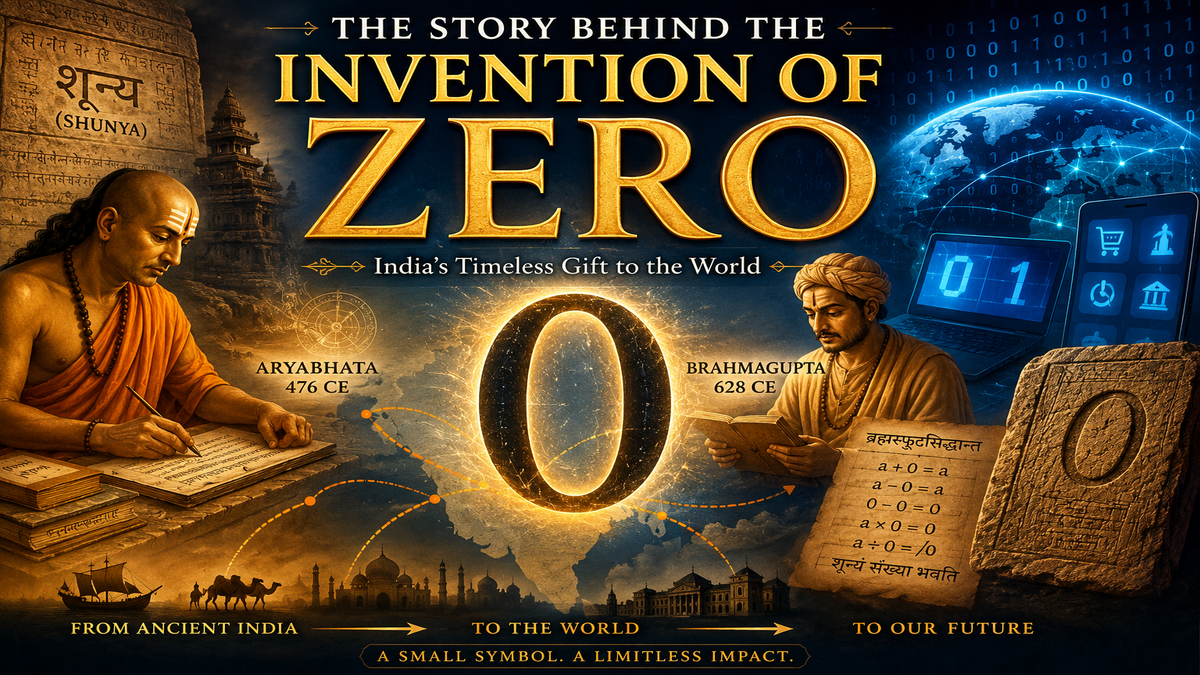
One of the first great Indian mathematicians was Aryabhata (476 AD). Aryabhata was an astronomer and mathematician of great genious whose contribution formed the basis for future advancements.
Aryabhata did not explicitly define zero as a number in the modern sense, but he made several groundbreaking contributions:
- Developed accurate astronomical calculations.
- Used a place-value system that required positional understanding of numbers.
- Worked with large numbers in ways that indirectly supported the concept of zero.
His mathematical framework made it necessary to represent empty positions in numerical structures, which was later utilized by other mathematicians who defined the concept of zero.
Aryabhata’s influence spread widely across India and later the world, shaping scientific thought for centuries.
Brahmagupta: The Man Who Defined Zero
The true definition of zero in mathematical terms dates back to the 7th century CE and was provided by Brahmagupta.
In his most celebrated work, Brahmasphutasiddhanta (628 CE), Brahmagupta did something extraordinary—he treated zero as a number with defined mathematical rules.
This was a turning point in the history of mathematics.
Brahmagupta’s Rules for Zero
He established rules such as:
- A number plus zero equals the number (a + 0 = a)
- A number minus zero equals the number (a − 0 = a)
- Zero subtracted from zero equals zero (0 − 0 = 0)
He also attempted early ideas of division involving zero, although this later led to refinements in modern mathematics.
For the first time in history, zero was not just a placeholder—it was a mathematical entity.
This was one of the greatest intellectual breakthroughs ever recorded.
The Birth of the Decimal System
Zero did not exist alone—it was part of a larger mathematical revolution: the decimal place-value system.
In this system:
- Numbers are based on powers of 10
- Position determines value (units, tens, hundreds, etc.)
- Zero acts as a placeholder to maintain structure
For example:
- 205 = 2 hundreds, 0 tens, 5 units
Without zero, this system would collapse.
Such an invention was faster, easier, and more exact than anything that existed before anywhere in the world, including Roman numbers, which were exceedingly difficult to use for multiplication and division.
This system in India became the basis of modern mathematics used all around the world today.
The Journey of Zero Beyond India
Knowledge about zero was not limited to India alone. The use of zero spread through trade and culture from continent to continent.
Mathematicians from India inspired scholars in the Islamic Golden Age.
Persian and Arab mathematicians adopted and refined Indian numerical systems.
The very word “zero” is the origin of the Arabic word “sifr,” which came from the Sanskrit “shunya.”
Subsequently, the Europeans came across this system when they translated Arabic books. Fibonacci is one of the key individuals who facilitated this process by introducing the Hindu-Arabic numeral system to Europe.
However, it took centuries for Europe to fully accept zero and the decimal system.
Afterwards, it changed the face of science, trading, and engineering in Europe forever.
Impact on the Modern World
Today, zero is the backbone of almost every modern technology.
Computers and Digital Systems
Computers operate on binary code:
- 0 = off
- 1 = on
Without zero, digital computing would not exist.
Science and Engineering
- Physics equations depend on zero-based calculations.
- Engineering designs rely on precise numerical systems.
- Astronomy uses zero-based coordinates and measurements.
Finance and Economics
- Banking systems rely on place-value arithmetic.
- Digital transactions, stock markets, and accounting systems use zero extensively.
Everyday Life
From measuring temperatures to GPS navigation, zero is everywhere.
In short, zero is the invisible foundation of the modern world.
Zero as a Philosophical Idea
The Indian philosophy is very much associated with the idea of zero through the term ‘Shunya’ that indicates nothingness, infinity, and equilibrium.
In texts influenced by Buddhist and Hindu thought:
- Emptiness is not nothingness—it is potential.
- The universe emerges from “shunya” and returns to it.
Perhaps, this philosophy made mathematicians conceive zero not only as an absence but as a meaningful entity.
This blending of spirituality and science is one of the unique features of ancient Indian intellectual tradition.
Common Misconceptions About Zero
There are several myths about the origin of zero:
- ❌ Zero was invented in Europe → Incorrect
- ❌ Ancient civilizations had no concept of zero → Incorrect
- ❌ Zero was always part of mathematics → Incorrect
Historical evidence clearly shows that:
- India was the first civilization to formalize zero as a number.
- Indian mathematicians created a complete numerical system using zero.
- This system later spread globally and became universal.
Legacy of Indian Mathematics
The invention of zero is just one example of India’s huge contribution to the field of mathematics.
Other achievements include:
- Early concepts of algebra
- Advancements in trigonometry (sine and cosine functions)
- Accurate astronomical models
Scholars such as Aryabhata, Brahmagupta, Bhaskara II, among others, defined the concepts behind math for hundreds of years.
Because of these contributions, India is often referred to as the birthplace of zero and one of the earliest centers of advanced mathematics.
Read More Articles👉: How PM Modi’s 2026 Gift Diplomacy, India’s First Great Empire, GI Tagged Crafts of India, The Cultural Significance of Yoga
A Small Symbol with Infinite Power
The history of zero is probably one of the most spectacular stories in the history of mankind. This number has gone through many changes and traveled in time from Indian manuscripts to supercomputers.
Something that started as just an abstract concept of ‘nothing’ has turned into something on which our whole world of science and technology is based.
India’s gift to the world was not just a number—it was a new way of thinking.
And perhaps the most beautiful irony is this:
The most powerful force in modern civilization is a symbol that represents nothing.
Zero is proof that even “nothing” can change everything.





Subscribe to Our Youtube Channel: https://www.youtube.com/@BhartiSanskriti-BS/