
Before India was recognized as an extensive and varied society, there were many kingdoms and republics on the subcontinent. Every area had its own rulers, separate aspirations, and many conflicts with others. In this environment of many nations and local governments, it would be difficult to establish an empire that ruled over a large area of land.
And yet, in the 4th century BCE, that is exactly what happened.
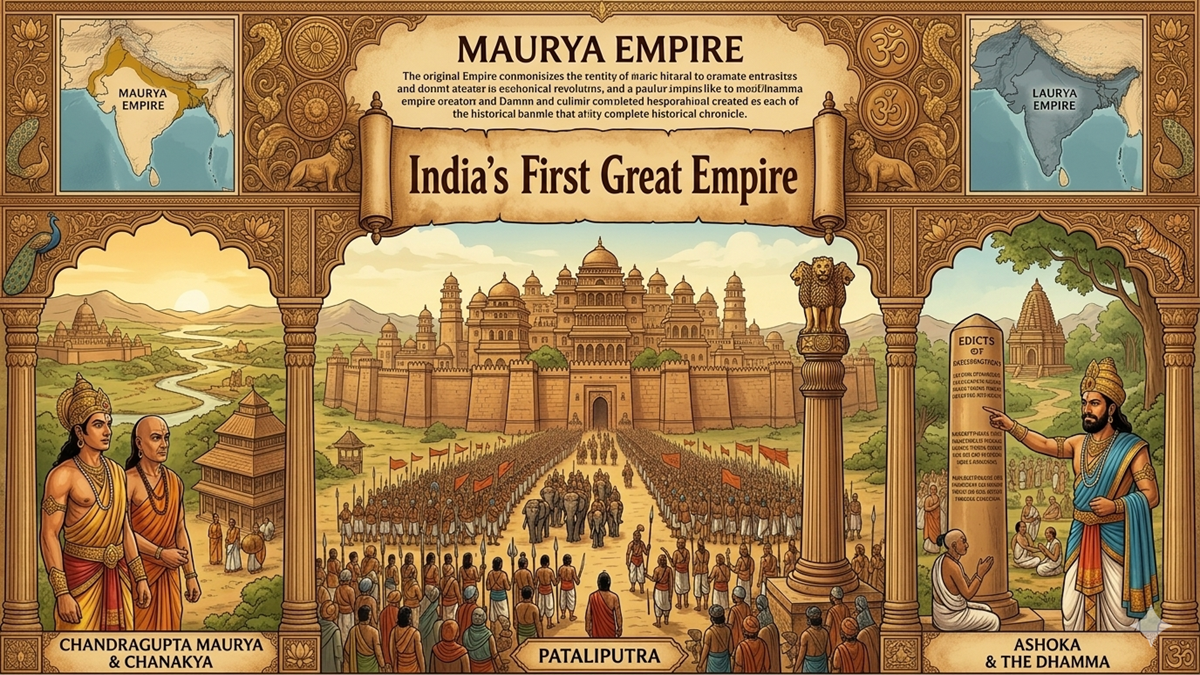
The Maurya Empire grew out of the chaos of fragmented rule to become the first true great empire of India. It was not just large in size but also organized, strong militarily, disciplined in administration, and historically significant. With kings such as Chandragupta Maurya and Ashoka, the Mauryas established a political structure that has influenced Indian history for hundreds of years.
What made the Maurya Empire so extraordinary was not just conquest. It was the ability to turn military power into political unity, and political unity into a lasting legacy. The empire became a model of centralized rule, strategic governance, and cultural influence. Its story is the story of India’s first true imperial age.
India Before the Mauryas
The Maurya Empire should be put into context with the rest of the world at the time that it was developing. The ancient Indian world consisted of many large territorial states or `Mahajanapadas’, some ruled by kings (monarchies), and many that operated in a more republican style of governance. Of these `Mahajanapadas’, the one that emerged most strongly over time was the kingdom of `Magadha’ for several reasons, including its fertile land, abundant river transport, and generally sound leadership.
Despite being divided, India existed as many different opposing kingdoms that were continually warring against each other for territory, trade & influence, and no one dominant power ruled all of the subcontinent. All of the stated powers acted independently from one another; they constantly relied on changing alliances with one another. For this reason, while local powers would be strong in their respective regions, they would be unable to come together and unify as one major power.
At this point in history, foreign invasions were highlighting the political fragility of the Indian subcontinent. The military expeditions undertaken by Alexander the Great in the northwest demonstrated that the local rulers themselves could not withstand the strength of coordinated attacks from abroad. Even though he did not stay in India long, his invasion demonstrated to what degree the region was divided.
This was the historical moment in which the Maurya Empire was born. The stage was ready for a leader with vision, ambition, and discipline.
Chandragupta Maurya: The Founder of an Empire
One of the most interesting tales in Indian history is that of the ascent of Chandragupta Maurya. There is little information about his younger life and many stories regarding where he came from, but they all agree that he came from an unknown background and eventually became well-known.
Born without an established royal lineage or throne, Chandragupta was destined through his own determination and effort to overcome personal hardship and form his own empire with the help of the best minds of the time. This became possible when he encountered Chanakya (Kautilya) – one of history’s greatest political minds – while both were exiled for various reasons and needed each other to build a long-lasting legacy for themselves and the Republic of India. In addition to being an exceptional strategist and warrior, Chanakya recognized great leadership potential in Chandragupta, as well as his ability to learn and grow intellectually.
Chanakya was more than just a teacher; he was a master strategist, planner, and political architect who was instrumental in the rise of the Maurya dynasty. Chanakya knew that having bravery was not enough to gain power, but also had other components, such as intelligence, timing, forming alliances, and proper statecraft. Together with Chandragupta, they created a team that will have an everlasting impact on India’s history.
The Nanda dynasty dominated Magadha during this time period. The rulers, though powerful, were not well-liked due to the traditions which indicate that they oppressed the people through extreme wealth and heavy taxation, as well as being arrogant in their approach to governing. Regardless of how anyone perceives them as a tyrant or ineffective ruler, they had established a significant amount of resentment with the emergence of a challenger.
Chandragupta came to power with Chanakya’s help by leading a successful military campaign against the Nandas. It was difficult because of the power of the Nandas as they had been ruling for several generations—however, strategy won out over inherited power. This happened around 322 BCE; once the Nandas were defeated by Chandragupta, he declared himself emperor and created the Maurya Empire with its capital located at Pataliputra—now Patna India (the city still exists today).
This was more than the rise of a new king. It was the beginning of India’s first major imperial state.
Military Strength and Expansion
Symbolism alone does not allow for the survival of a large empire. In order for an empire to survive, it must have the capacity for defending itself from attack, to expand its area of influence, and to maintain order throughout an area with large geographical areas.
The Mauryan Empire demonstrated these concepts well. Chandragupta successfully built a powerful military engine that supported the capabilities of the Mauryan military. The accounts of the Mauryan Empire from historical texts indicate that the Mauryan military was very large and had an organized manner (such as having infantry, cavalry, chariots, and elephants), which allowed it to expand and to hold large territories. However, the Mauryan military was an instrument of state power, rather than merely a collection of fighters.
After conquering Magadha, Chandragupta expanded the Mauryan Empire through military expeditions in the north and center of India. The most significant of these expeditions was against Seleucus I Nicator, one of Alexander’s generals. Chandragupta defeated Seleucus and signed a treaty with him that solidified the power of the Mauryan Dynasty as well as granted Maurya’s control over valuable resources.
This settlement was especially significant because it brought parts of the northwest under Mauryan control and established diplomatic relations with the Hellenistic world. The empire was no longer a local kingdom. It had become a major power on the world stage.
The Maurya Empire was remarkable both for the size and the speed/assuredness of its successive expansion. Through his work, Chandragupta demonstrated to Indian leaders that large, centralized empires could be constructed and maintained, thereby establishing legitimacy that would allow them to compete with any of the major empires from antiquity to the present.
The Genius of Mauryan Administration
Although military conquests enable an empire’s original creation, administrative functions make its existence possible for many years. In this respect the Maurya Empire excelled.
The Maurya Empire had a centralized structure with an emperor on top, a system of governors and their staffs throughout the provinces, a system of treasurers, a system of tax collectors, and a system of spies which networked them together. This central administrative structure made it possible for the Maurya Empire to exist in a relatively orderly manner across geographically far-apart regions of the Maurya Empire.
The Arthashastra has traditionally been regarded as one of the best sources to understand how the Mauryan Empire was administered – it was written about statecraft in great detail, including topics such as government operation, tax collection, diplomacy, intelligence gathering, agricultural production, defence, and providing for the general welfare. The authorship of all sections may not have been due to Chanakya, but he is certainly reflects political sophistication during the Mauryan Movement.
The empire was divided into different parts, each with their own governor to enforce the will of the central government over a large and varied population. In addition, taxes were collected in an orderly fashion for a variety of purposes such as maintaining an army, building roads, and running the governmental operation.
One of the things that helped make the Maurya Empire a powerful force in India was a very effective administration. Instead of being ruled by just brute strength, it had a lot of planning, organization, and structure to help maintain order and control.
Economic Strength and Trade
No empire can remain great without a strong economic base. The Maurya Empire understood this perfectly.
Mauryan wealth was built upon agriculture as its base. The fertile plains of the Ganga basin allowed for extensive agriculture; and through irrigation and land management, the state supported and promoted this production. Agriculture was very important to the largesse (support) of both the populace and the army; therefore, it was an area of state interest.
Trade and commerce were promoted by the Mauryan Empire. The vast network of roads, rivers, and cities of the Mauryan Empire allowed for the transportation of goods between different regions by merchants. Because of India’s central location in relation to long-distance trade with other countries, the Mauryan Empire became a natural center of long-distance trade. Through these connections, goods from various parts of the Mauryan Empire were traded with Central Asia, the Persian Empire and other neighbouring countries.
The development of coins and a standardized system allowed commerce to be done more efficiently than previously. Cities became larger and more important, and functioned not only as administrative centers, but also as locations for the production of crafts and trade. Pataliputra, in particular, has been described by later writers as a large, well-organized city that illustrated the sophistication and wealth of the empire.
The stability of a strong economy provided the Maurya Empire with the required resources for paying soldiers, supporting officials, maintaining infrastructure and projecting military might. As such, much of the empire’s strength came from battlefields as well as the marketplace or agricultural production.
Ashoka: Power Transformed by Compassion
If Chandragupta built the empire, Ashoka transformed its meaning.
The grandson of Chandragupta Maurya’s Ashoka was among history’s most significant figures. He seems like an ambitious and very victorious emperor with power and expanded wealth when he first begins to reign. However, one event during this time would change the direction of his life for all time: the war in Kalinga.
Located along the eastern coast, Kalinga, a region was in rebellion to being governed by the Mauryan Empire. Although Ashoka conquered Kalinga through a successful campaign, the end result was catastrophic. Accounts from ancient times document vast destruction and extensive loss of life due to the violent nature of war. The barbarity and bloodshed that resulted from this battle made a very significant impact on Ashoka. Witnessing the devastation caused by war changed Ashoka’s perspective significantly.
Following his conquest of the Kalinga in 286 BCE, Ashoka embraced an ethical, moral guide known as dhamma. Dhamma includes many principles such as non-violence (ahimsa), compassion, respectful treatment of others (which would be called “tolerance” today), and effective, accountable governance through just ruling. Ashoka’s acceptance of dhamma was more than simply his adoption of a new religious belief; it was also a complete redefinition of what it means to be a ruler.
Ashoka saw being a king today not only as a source of power over others but also seeing kings are to serve the people of their society too. The Emperor of the Mauryan Empire promoted the welfare of the people by promoting good behaviour, promoting respect for all people, regardless of religion, caste, community or social group. He created large numbers of inscriptions on pillars and other sources to promote these values for the people he oversaw and was one of the first to use inscriptions throughout India.
The edicts carry great authority due to the perspective of an expansive emperor. For Ashoka, greatness was associated with having a sense of moral duty as a king, and in that way, he established an identity for his Empire that is distinctive among all other ancient countries.
Cultural and Religious Influence
The Maurya Empire was not only a political achievement. It was also a cultural turning point.
Buddhism was expanded significantly by Ashoka. Support from Ashoka allowed Buddhism to expand well beyond its original regional boundaries and spread to various areas of Asia. Missionaries travelled to other lands, including Sri Lanka, where Buddhism established strong roots. Hence, over time, this led to Buddhism becoming an overall world religion.
There were also several other noteworthy developments in art and architecture during the Maurya are. The columns, carvings, polished columns, stone pillars, stupas etc. of this time all show the theme of imperialism and spirituality. The Lion Capital of Ashoka (the origin of India’s presently used emblem) is a strong visual representation of India’s statecraft and ancient culture.
The Mauryan dynasty impacted many cultural aspects and continues to influence our society today. They had a major effect on how people view religion, art, government ideas and how we remember people that were part of the Mauryan dynasty. Their empire was also the model upon which future Indian empires would build their own concepts of kingship and governance.
Why the Maurya Empire Succeeded
The Maurya Empire became India’s first great empire because several strengths came together at the right moment.
The empire was successful for many reasons. The first was the visionary leadership of Chandragupta, who was courageous enough to challenge the existing powers, and Ashoka, with his ability to redefine the nature of an empire. Second was Chanakya’s brilliance in creating the structure of the empire. Third was a strong military capable of both conquering territory and defending it. Fourth was a well-organised administrative system so that an empire can run over long distances. Finally, there was economic might, which allowed for the empire to last for many years.
These factors worked together in a way rarely seen in early Indian history. The Mauryas did not rule by accident. They built a system.
Decline and End of the Empire
Great empires eventually fall. Following Ashoka’s death (ca 232 BCE), the Mauryan Empire began to weaken. His successors did not have the same level of authority or vision as Ashoka had done; therefore, as the level of central power decreased, the regions of the empire became increasingly difficult to control. Fragmentation occurred due to the internal problems associated with the decline of central authority, administrative strain, and political instability.
The Mauryan Empire had disappeared from existence by 185 B. C., still the fall of this empire should not take away from its significance. That achievement was impressive enough on its own base of fragmented territories but leaving a legacy that continued well after the Mauryan Empire was gone is equally impressive.
Legacy: Why It Still Matters
India’s Maurya Empire is a unique marker in the history of India as it demonstrated that a single government could unite the entire sub-continent politically. The Maurya also established a model for subsequent dynasties to follow; this model was developed through strategies of centralized governance, administrative capacities, and imperial ideas.
Its significance is that it shows the difference between Chandragupta and Ashoka. Chandragupta represents power expansion and state-building, while Ashoka represents reflection, ethical governance and moral transformation; the two men together highlight all of the leadership qualities we associate with them.
The legacy left behind by the Mauryans still has value in the modern world. The mistake of not combining power with wisdom means you’ve created an incomplete form of power. Without having the moral responsibility to guide you, then strength will never be considered true strength. Finally, it illustrates how India’s past has been made up of so much more than just kings and fighting; it has also been made up of ideals that embrace unity, civil service, and a relationship between man and God.
Conclusion
The first great empire in Indian history was the Maurya Empire, which united the various components of a successful government and established the basis of enduring greatness. Its foundation was built by Chandragupta Maurya; its intellectual base was established by philosophically trained philosopher Chanakya; while its ethical base was founded by Ashoka.
The Maurya aligned power from the fall of the Nandas to the change in Kalinga, where it represented the rise, power and impact of India. It is also the tale of unity among disparate nations under one ruler, thus making that ruler an architect of future civilizations in India.
The Maurya Empire was not just a chapter in history. It was the beginning of imperial India.
Subscribe to our YouTube Channel: https://www.youtube.com/@BhartiSanskriti-BS/