
Table Of Contents
Contents
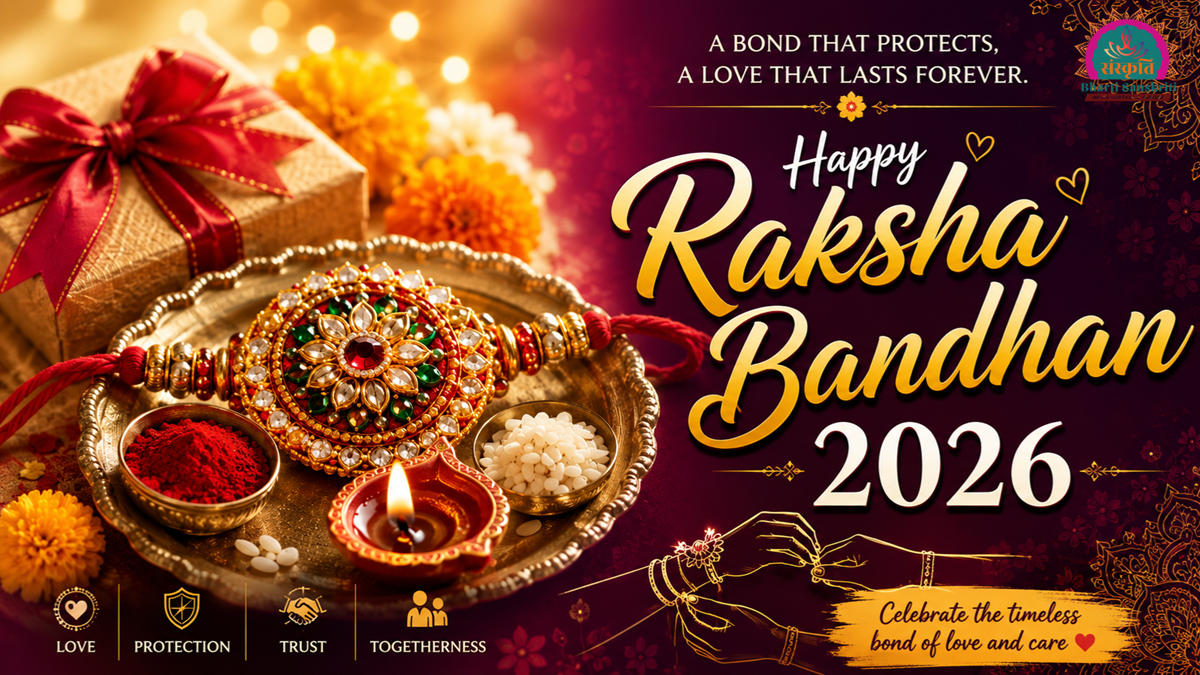
Raksha Bandhan is one of the most loved festivals of India, which highlights the bond of love, faith, and togetherness between brothers and sisters. In 2026, the day of Raksha Bandhan will fall on 28th August, as it is celebrated during Shravan Purnima.
Traditionally, the festival is celebrated when the sister ties a rakhi around the brother’s wrist, applies a tilak, and presents sweets. In return, the brother presents a gift and pledges to protect his sister. However, in modern times, Raksha Bandhan has transformed into a celebration of mutual care, emotions, and relations among families.
Raksha Bandhan 2026 Date and Muhurat
Raksha Bandhan is celebrated on the full moon day of the Hindu month of Shravan, also known as Sawan. This full moon is called Shravan Purnima.
In 2026, the Purnima tithi will begin at approximately 9:08 AM on Thursday, 27 August, and end at around 9:48 AM on Friday, 28 August. Since the full moon is present at sunrise on 28 August, the festival will be celebrated on that day.
The auspicious time for tying rakhi in New Delhi is expected to be between around 5:57 AM and around 9:48 AM on 28th August 2026. The actual time may vary based on the geographical time zone, time of sunrise, and time based on the calendar followed by one’s family.
| Detail | Information |
| Festival | Raksha Bandhan 2026 |
| Date | Friday, 28 August 2026 |
| Tithi | Shravan Purnima |
| Purnima begins | 9:08 AM, 27 August 2026 |
| Purnima ends | 9:48 AM, 28 August 2026 |
| Suggested rakhi muhurat | Approximately 5:57 AM to 9:48 AM |
| Other names | Rakhi, Rakhi Purnima |
People who follow a particular religious tradition should confirm the ceremony timing with a local calendar or priest, especially when celebrating outside India.
The Good News for 2026: No Morning Bhadra Kaal
The most reassuring thing about Raksha Bandhan 2026 is the absence of the morning Bhadra Kaal on this occasion. So, families will have the opportunity to perform this ritual knowing, during the auspicious time, that the Bhadra will definitely not disturb them.
As per Hindu traditional beliefs regarding calendrical matters, Bhadra is an inauspicious time during which certain activities that are otherwise regarded as auspicious, such as the tying of rakhi, must be avoided. Because of this reason, people avoid carrying out the ceremony at this time.
In 2026, the Purnima tithi is present on the morning of 28 August, as Bhadra does not act as a hindrance during the principal morning muhurat. The given morning period from about 5:57 AM to 9:48 AM is the perfect time for families to carry out the rakhi ceremony.
This is especially beneficial to families that wish to stick to traditional timing yet handle work, school, and travel schedules. Brothers and sisters can start off their day with prayers, tilak, rakhi-tying, and exchanging sweets without looking for a time later in the day.
Nonetheless, the muhurat may differ depending on your location, time of sunrise, and the type of panchang you are consulting. It is therefore advisable for families to confirm local timing before proceeding with the date of the ceremony. The general message for Raksha Bandhan in 2026 appears to be on the positive side as there is no element of the Bhadra Kaal in the morning celebrations.
What Does Raksha Bandhan Mean?
The name Raksha Bandhan comes from two Sanskrit words: raksha, meaning protection, and bandhan, meaning bond or tie. Together, the term refers to a bond of protection.
Rakhi in itself does not just represent a thread of decoration. It stands for understanding, duty, belief, and your guarantee to be there in times of difficulty. According to tradition, a brother promises to take care of his sister, while the sister prays for his good health and prosperity.
Currently, people comprehend the meaning of protection in broader terms. A brother can support his sister emotionally and a sister can assist her brother in studies, career challenges or personal struggles. Siblings protect each other by giving each other advice, providing support and being with one another.
This changing interpretation makes Raksha Bandhan relevant to contemporary families. The festival is no longer limited to a one-sided promise. It can represent a mutual commitment:
“मैं तुम्हारी खुशी, सम्मान और सपनों का साथ दूंगा या दूंगी।”
Historical and Mythological Stories
There are many popular legends related to Raksha Bandhan. These myths form part of India’s culture and tradition, even though not all of them are considered historically valid accounts.
Krishna and Draupadi
One of the most famous tales links Raksha Bandhan with Lord Krishna and Draupadi. As per the popular tale, Krishna hurt his finger while operating the Sudarshan Chakra. On realizing the injury, Draupadi ripped a piece from her sari and wrapped it around his finger to prevent blood loss.
Krishna was touched by her affection and is believed to have promised to protect her whenever she needed him. The story is often associated with the values of gratitude, compassion, and the strength of a personal promise.
It also suggests that even a small act of kindness can create a lasting emotional bond.
Rani Karnavati and Humayun
There is a widely circulated historical account telling that when Rani Karnavati of Mewar was confronted with the threat of warfare, she sent a rakhi to Humayun, the Mughal emperor, who accepted it and felt obligated by the relationship.
Scholars have questioned this account with respect to the particulars and authenticity of the story. It is, therefore, preferable to regard it as a popular formulation rather than a fact in history. Still, the tale has contributed to forming the idea of rakhi as a symbol of unity that transcends the boundaries of class, politics and religion.
Yama and Yamuna
Certain customs of Raksha Bandhan are believed to be linked to Yama, whom people recognize as god of death, and his sister Yamuna. According to a popular belief, Yamuna put a holy thread on Yama and treated him with great kindness. As a result, Yama granted her a wish, promising that brothers receiving rakhi from their sisters would live long and be safe and sound.
This story emphasises the importance of sibling affection and the wish for the well-being of loved ones.
Why Is Raksha Bandhan Celebrated?
Raksha Bandhan is celebrated for several emotional, cultural, and social reasons.
To begin with, it gives siblings a chance to talk about feelings that might not otherwise be communicated. Everyday life is usually very demanding for family members. Raksha Bandhan creates a perfect occasion to remain in touch with one another.
Additionally, this festival honors gratefulness. The festival provides a means for siblings to show appreciation for what they have done for each other. A sister might remember how her brother used to help her at a time of difficulty, and a brother might appreciate the emotional support received from his sister.
Thirdly, it boosts family ties. In several families, family members travel long distances to celebrate Rakhi together. In general, the event is followed by a family meal, talking, taking pictures, and exchanging gifts.
Finally, Raksha Bandhan keeps cultural traditions alive. Children learn about family customs by participating in the ceremony and observing elders. In this way, the festival becomes a bridge between generations.
Traditional Raksha Bandhan Rituals
The rituals of Raksha Bandhan may vary from one family or region to another, but the basic ceremony remains simple.
Preparing the Rakhi Thali
A traditional rakhi thali usually contains:
- Rakhi.
- Roli or kumkum.
- Akshat, or uncooked rice grains.
- Diya.
- Flowers.
- Sweets.
- Incense, according to family tradition.
- A small gift or envelope.
The items are arranged neatly before the ceremony. Some families decorate the thali with flowers, rangoli or handmade designs.
Rakhi Puja Vidhi
The ceremony generally follows these steps:
- The sister prepares the thali and welcomes her brother.
- She applies a tilak of roli or kumkum to his forehead.
- Akshat is placed over the tilak as a symbol of auspiciousness.
- She performs aarti with a lit diya.
- She ties the rakhi on her brother’s wrist.
- The brother offers sweets to his sister, and she feeds him a sweet as well.
- Both siblings exchange gifts and seek the blessings of elders.
- The family prays for the health, happiness, and prosperity of everyone.
Some families recite mantras or prayers during the ceremony. Others celebrate in a simpler way, focusing on the emotional meaning of the occasion.
Raksha Bandhan Gift Ideas
A gift does not need to be expensive to be meaningful. The best gift is one that reflects the recipient’s interests and needs.
| Category | Gift Ideas |
| Budget-friendly | Books, chocolates, plants, stationery and handwritten cards |
| Useful | Wallet, bag, headphones, bottle, desk organiser or watch |
| Personalised | Photo frame, customised mug, engraved accessory or scrapbook |
| Experience-based | Family lunch, movie outing, workshop or short trip |
| Sustainable | Handmade products, reusable items, organic products or plant kits |
| For students | Study lamp, planner, exam books, backpack or online course |
A handwritten note can make even a simple gift special. Siblings can write about a favourite childhood memory, a difficult moment they overcame together or a hope for the future.
Raksha Bandhan and Social Values
Raksha Bandhan has an important place in Indian social life because it encourages emotional expression and family solidarity. It reminds people that relationships require time, communication, and care.
The festival can promote a better understanding of accountability. The word “protection” should not refer to restricting or controlling someone or treating them unfairly. Respect, freedom and mutual support are essential in a healthy sibling relationship.
For young people, Raksha Bandhan can become an opportunity to discuss important values such as:
- Respecting one another’s choices.
- Supporting education and career goals.
- Standing against harassment and discrimination.
- Sharing family responsibilities.
- Maintaining emotional availability.
- Respecting personal boundaries.
In this sense, the modern rakhi can symbolise not only physical safety but also dignity, equality and encouragement.
Do’s and Don’ts for Raksha Bandhan 2026
Do’s
- Confirm the local ceremony timing if following a specific panchang.
- Order rakhis and gifts early for long-distance delivery.
- Choose handmade or eco-friendly rakhis.
- Include grandparents and other family members.
- Select useful and personal gifts.
- Celebrate mutual support between siblings.
- Avoid making the festival a competition based on the price of gifts.
Don’ts
- Do not treat protection as the responsibility of only one gender.
- Do not pressure anyone to follow a ritual against their wishes.
- Avoid excessive plastic decoration.
- Do not waste food during large gatherings.
- Do not exclude siblings who are unable to attend in person.
- Avoid reducing the festival to social-media photographs and shopping alone.
Explore More Interesting Articles👉 : The Story of Mahabodhi Temple, Jagannath Puri, Pitru Paksha Mela in Gaya Ji, Akshaya Tritiya . . . e.t.c
Conclusion
Raksha Bandhan 2026 will be celebrated on Friday, 28 August, with the rakhi ceremony generally planned during the morning muhurat. A major positive point for devotees is that there is no morning Bhadra Kaal affecting the principal rakhi-tying period, allowing families to celebrate conveniently in the morning.
More than a religious ritual, the festival is a celebration of memories, affection, responsibility and family connection. The rakhi may be a simple thread, but its meaning is deep. It carries childhood memories, promises of support and the comfort of knowing that someone will stand beside us during difficult times.
This Raksha Bandhan, families can celebrate the tradition while also giving it a modern meaning—mutual respect, equality, emotional support and care for one another. Because the real strength of Raksha Bandhan is not in the thread tied around the wrist. It is in the promise that siblings continue to remain connected, even when life takes them in different directions.

Subscribe to Our YouTube Channel: https://www.youtube.com/@BhartiSanskriti-BS