
Table Of Content
Contents
Krishna Janmashtami is considered to be one of the most famous festivals in Hinduism that celebrates the birth of Lord Krishna. This year, the festival will be celebrated on 4 September, Friday, by most of the Hindu families from those following the Smarta tradition, while it shall be celebrated by the ISKCON authorities and the Vaishnavas on 5 September, Saturday.
The features of the festival include fasting, puja at midnight, singing of devotional songs, and preparing elaborate food for the little Krishna through various offerings. People all over India are busy decorating their homes and temples, singing bhajans all night long, and celebrating the occasion with zeal and zest. The article preserves everything about Krishna Janmashtami 2026, including dates, time, rituals, and significance.
Krishna Janmashtami 2026: Date and Important Timings
Krishna Janmashtami is celebrated on the Ashtami Tithi, i.e., the 8th day, during Krishna Paksha (the waning phase of the moon) in the month of Bhadrapada according to the Hindu calendar. It falls on the day of the Rohini Nakshatra, which is said to be particularly favorable for worshiping Krishna.
Ashtami Tithi in the year 2026 will commence on September 4 at 2:25 AM and end on September 5 at 12:13 AM. Rohini Nakshatra will be observed on September 4 from 12:29 AM to 11:04 PM. The Nishita Puja, the most important ritual of Ashtami Tithi, takes place at midnight, which is believed to be the time of Lord Krishna’s birth.
| Detail | Information |
| Festival | Krishna Janmashtami 2026 |
| Main observance date | Friday, 4 September 2026 (Smarta tradition) |
| ISKCON/Vaishnava date | Saturday, 5 September 2026 |
| Ashtami Tithi begins | 2:25 AM, 4 September 2026 |
| Ashtami Tithi ends | 12:13 AM, 5 September 2026 |
| Rohini Nakshatra | 12:29 AM to 11:04 PM, 4 September 2026 |
| Nishita Puja Muhurat (Delhi) | 11:57 PM, 4 Sep – 12:43 AM, 5 Sep |
| Also known as | Gokulashtami, Sri Krishna Jayanti, Janmashtami |
These timings are approximate and may vary according to location and the panchang followed. Devotees should verify the exact muhurat with their local temple or religious calendar.
Why Are There Two Dates for Janmashtami?
One common question among devotees is why Janmashtami is celebrated on two different dates. This difference arises from varying calendrical calculations followed by different traditions.
Smarta Tradition (4 September)
Most of the households in India follow the Smarta tradition. This tradition explains the observance of Janmashtami when the Ashtami Tithi and the Rohini Nakshatra happen to occur together at midnight. This intersection of dates occurs on September 4, 2026, which falls on Friday.
Vaishnava/ISKCON Tradition (5 September)
The way of calculating the lunar calendar followed by ISKCON temples and several Vaishnava communities is quite different from the usual methods. This is because of their unique astronomical calculations, which can lead to variations in observance days in some years. For example, in the year 2026, ISKCON will perform Janmashtami on Saturday, the 5th of September.
Both of the traditions are equally important and spiritually significant. Hence, devotees are expected to follow the tradition of their family, community, or spiritual organization. The whole essence of the festival remains the same: devotion to Krishna and celebration of his divine birth.
What Is the Significance of Krishna Janmashtami?
The Birth of Lord Krishna
According to Hindu tradition, it is believed that Krishna was born during Dvapara Yuga in Mathura, located in present-day Uttar Pradesh. Krishna is said to be the eighth avatar of Lord Vishnu. His birth was meant to conquer the evil ruler, Kamsa or Kansa, and restore dharma. He was born in Krishna Paksha during the month of Bhadrapada, on Ashtami Tithi under the Rohini Nakshatra, at midnight.
Spiritual Meaning
Krishna is a symbol of divine love, wisdom, joy, and virtue. Through his story told in the Bhagavata Purana and other texts, we learn important lessons on duty, devotion, detachment and reality. The festival serves as a reminder for worshippers to embody Krishna’s traits in their own lives and to follow the path of dharma.
Janmashtami is not simply a historical celebration, but a spiritual chance to contemplate one’s life, conquer one’s evil ways and develop qualities like kindness, honesty and selfless service.
Cultural Importance
Janmashtami is observed throughout India with significant regional variations. From the grand temple festivities in Mathura and Vrindavan to the exciting Dahi Handi events in Maharashtra, Janmashtami helps strengthen the bonds of communities through prayers, fasting and festivities. It keeps old practices alive through songs, dances, plays and stories.
The Story of Krishna’s Birth
The narrative of Krishna’s birth is one of the most compelling stories in Hindu mythology, filled with divine intervention, courage and devotion.
The Prophecy and Imprisonment
Kamsa, the tyrannical king of Mathura, has imprisoned his own sister Devaki and her husband Vasudeva after being warned by the prophecy that Devaki’s eighth son will kill him and take charge of his kingdom. Out of rage and fear, King Kamsa killed Devaki and Vasudeva’s first six children immediately after their birth.
The Divine Birth
When the eighth child was conceived, the divine powers were at work. The guards fell asleep at the time when Lord Krishna was born, freeing Bhagwan Vasudeva and Goddess Devaki from their chains. Krishna was born at midnight under the constellation of Rohini.
Vasudeva carried the child to the turbulent Yamuna River and reached Gokul. Here he left Krishna in exchange for the infant daughter of his friend Nanda and his wife Yashoda and returned with the girl. The next day, when Kamsa went to kill the newborn, she vanished from his arms and went up to heaven, proclaiming herself to be the goddess Yogamaya and announcing that Krishna was safe in Gokul.
Krishna’s Childhood in Gokul
In Gokul, Krishna spent his entire childhood with his mother Yashoda and father Nanda. His life as a child is full of miracles, joys, and divine lessons. He vanquished demons, held on to the Govardhan Mountain to safeguard the villagers from the fury of Indra, and performed many other wonderful deeds.
Finally, Krishna came back to Mathura, obeyed the prophecy by overcoming Kamsa, and established dharma. His life went on, offering great teachings, such as the Bhagavad Gita, which is still a source of inspiration for oodles of people today.
“वह मध्यरात्रि केवल एक जन्म नहीं था, बल्कि अधर्म पर धर्म की विजय का प्रतीक था।”
Fasting and Vrat Rules for Janmashtami
Fasting is an integral part of Janmashtami observance. Devotees fast to purify the body and mind, express devotion, and prepare for the midnight puja.
Types of Fasts
Nirjala Vrat: A complete fast without water until the midnight puja is completed. This is observed by those who are physically able.
Phalahar Vrat: Consuming fruits, milk, curd, nuts, and specific sattvic foods. This is a common choice for many families.
Partial fast: Avoiding grains, onions, garlic, and certain spices while consuming other permitted foods.
Fasting Guidelines
- Begin the fast on Ashtami Tithi, ideally after a morning bath.
- Avoid grains such as rice, wheat, and lentils.
- Avoid onions, garlic and certain spices considered tamasic.
- Consume sattvic foods like fruits, milk, curd, nuts, sabudana, kuttu ka atta and singhare ka atta.
- Break the fast after the midnight puja on Navami Tithi, following the completion of rituals.
Who Should Fast?
Devotees in search of spiritual development, people expressing their gratitude to Krishna and families wishing to follow traditions observe fasting. Nonetheless, fasting needs to be performed within the limits of one’s health. Old people, women in pregnancy, children and those suffering from some illness must see a doctor before fasting or choose easier ways of fasting according to their health condition.
Janmashtami Puja Vidhi: Step-by-Step Ceremony
The Janmashtami puja is a beautiful ritual that brings families together in devotion. While customs vary, the following steps provide a general framework.
Preparation Before Puja
- Clean the home thoroughly, especially the puja area.
- Decorate with flowers, rangoli, lights and traditional torans.
- Prepare a jhula (cradle) for baby Krishna, decorated with flowers and fabric.
- Arrange puja items: Krishna idol or picture, incense sticks, diya, flowers, sweets, fruits, panchamrit (milk, curd, honey, ghee and sugar), conch, bell, camphor and new clothes for Krishna.
Puja Steps
- Sankalp: Take a vow to observe the fast and perform the puja with devotion.
- Bath and Dress: Bathe early in the morning and wear clean, preferably new, clothes.
- Kalash Sthapana: Install a sacred pot filled with water, topped with mango leaves and a coconut.
- Ganesha Puja: Invoke Lord Ganesha for auspicious beginnings and removal of obstacles.
- Krishna Abhishek: Bathe the Krishna idol with milk, curd, honey, ghee, water and panchamrit.
- Alankar: Dress Krishna in new clothes and adorn with ornaments, flowers and a crown.
- Jhula Decoration: Place the decorated Krishna idol in the cradle and gently rock it.
- Aarti and Bhajans: Sing devotional songs, chant Krishna mantras, and perform aarti with camphor or ghee diya.
- Prasad Distribution: Offer sweets and food to Krishna, then distribute prasad to family and guests.
- Parana: Break the fast after the midnight puja is completed on Navami Tithi.
Midnight Puja (Nishita Kaal)
The most significant ritual happens during Nishita Kaal, which is the midnight period in which Krishna is said to have been born. In 2026, this time period begins at about 11:57 P.M. and ends at around 12:43 A.M. in Delhi, though actual times will differ from one place to another.
People perform bhajans, ring bells, blow conch, and celebrate the birth of Lord Krishna during this period of the festival. The idol is swayed in the jhula, and the family members offer flowers, agarbatti, and prayers. Aarti is conducted with sincere faith, and the whole area is charged with joy.
Chappan Bhog: The 56 Offerings to Krishna
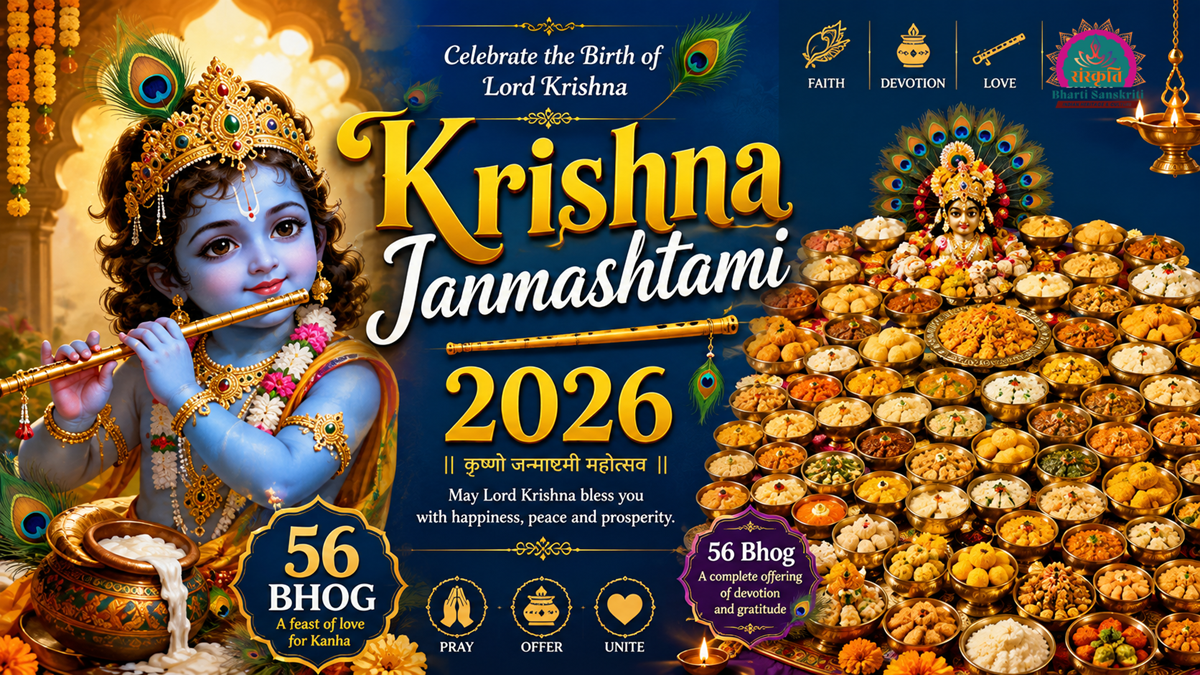
One of the most distinctive traditions of Janmashtami is the preparation of Chappan Bhog, or 56 food items offered to Krishna.
What Is Chappan Bhog?
The term Chappan denotes the number 56 in Hindi. Based on popular beliefs, Krishna would consume food eight times a day since birth in Gokul. Therefore, in seven days’ time, there would be a total of 56 meals served. So, followers prepare a feast of 56 different foods, which they present to Krishna with devotion.
Common Items in Chappan Bhog
- Sweets: Ladoo, pedha, kheer, halwa, rabri, malpua, shrikhand
- Dairy: Milk, curd, butter, ghee, chhachh (buttermilk), paneer
- Fruits: Banana, apple, mango, grapes, pomegranate, coconut
- Savouries: Mathri, pakora, kachori, samosa, chakli
- Drinks: Thandai, sherbet, fresh juice, lassi
- Other: Rice dishes like kheer, lentil preparations, dry fruits, nuts
It may not be convenient for all families to make all 56 kinds of offerings. A lot of families prepare simpler meals with either 16 or 21 or 32 offerings, according to their abilities. It is important to keep in mind that it is the intention and commitment that count in this case, rather than the number of dishes prepared.
How Janmashtami Is Celebrated Across India
India’s diverse cultural landscape is reflected in the varied ways Janmashtami is celebrated across different regions.
Mathura and Vrindavan
As the Places where Krishna was born and raised, Mathura and Vrindavan are sites of heartfelt celebrations. Temples become lit up like never before with flowers and elaborate rangoli designs. Devotees have special opportunities for darshan, and aartis at midnight attract thousands of devotees. A variety of cultural programs, bhajan-kirtan performances, and processions take place during the celebrations.
Maharashtra
The next day after Janmashtami is celebrated with the event Dahi Handi in Maharashtra. During this occasion, young guys make human pyramids in order to break the pot with curd hanging from above the ground. The essence of Dahi Handi lies in the playful nature of Krishna’s childhood when he used to steal butter from the houses.
South India
The festival in South India is called Sri Krishna Jayanti or Gokulashtami. Homes are adorned with kolams that show baby Krishna’s footprints, which denote his coming into the house. The temples have special prayers and preparation of sweet dishes. Devotees fast and perform puja with a lot of devotion.
Other Regions
- Gujarat: Devotional singing, temple celebrations and community gatherings.
- Karnataka: Fasting, home puja and distribution of prasad.
- Tamil Nadu: Drawing Krishna’s footprints at entrances and preparing special offerings.
- West Bengal: Cultural programs, bhajan gatherings and temple celebrations.
- Rajasthan: Folk songs, traditional dances and elaborate temple decorations.
Modern Ways to Celebrate Janmashtami
For Families Living Apart
Contemporary lifestyles have influenced how families celebrate Janmashtami, especially when relatives live in different cities or countries.
- Organise virtual puja and bhajan sessions through video calls.
- Send prasad, sweets, and gifts via online delivery services.
- Share photos and videos of celebrations with distant family members.
- Participate in live-streamed temple aartis and kirtans.
- Coordinate midnight puja timings across time zones for virtual celebration.
Eco-Friendly Celebrations
- Use clay or biodegradable idols instead of plaster of Paris.
- Create rangoli with natural colours, flowers or rice flour.
- Reduce plastic decoration and use cloth, paper or leaf-based materials.
- Offer organic and locally sourced food items.
- Minimise waste by planning food quantities carefully.
- Donate excess food to those in need.
Teaching Children About Krishna
- Share Krishna’s stories through age-appropriate books, videos and animations.
- Involve children in puja preparation, such as making decorations or arranging flowers.
- Teach simple bhajans, shlokas and Krishna mantras.
- Explain the values Krishna represents: love, truth, courage and compassion.
- Encourage acts of kindness, sharing and helping others in Krishna’s name.
- Organise storytelling sessions or quiz competitions about Krishna’s life.
Janmashtami and Spiritual Values
Beyond the rituals and celebrations, Janmashtami carries profound spiritual significance that remains relevant in contemporary life.
The life of Krishna demonstrates how to reconcile the two opposites of duty and devotion, action and renunciation. The essence of his teachings in the Bhagavad Gita refers to the central human questions on the way of a person towards righteous and virtuous living, overcoming fear and uncertainty, as well as obtaining inner stillness amid the storms of existence.
The festival promotes introspection and spiritual development. It prompts devotees to look at their lives and get rid of their egos and vices and develop positive qualities such as love, compassion, truth and righteousness. Krishna’s mischievous character also suggests that spirituality does not have to be serious; it can be fun and imaginative.
“कृष्ण का जन्म केवल एक त्योहार नहीं, बल्कि अपने भीतर के अंधकार को मिटाने का अवसर है।”
Important Do’s and Don’ts
Do’s
- Confirm local puja timings with the panchang or temple authorities.
- Prepare the puja area and items in advance.
- Involve all family members in celebrations and rituals.
- Choose sattvic foods for fasting and prasad preparation.
- Keep the celebration devotional, peaceful and joyful.
- Respect different traditions and dates followed by various communities.
- Share prasad with neighbours, friends and those in need.
- Maintain cleanliness and hygiene during celebrations.
Don’ts
- Do not perform puja during inauspicious times or without proper preparation.
- Avoid non-vegetarian food, alcohol and intoxicants on this sacred day.
- Do not waste food during celebrations; plan quantities carefully.
- Avoid excessive spending on decorations or gifts beyond one’s means.
- Do not neglect health while fasting; modify according to physical capacity.
- Avoid arguments, negativity or conflicts on this auspicious occasion.
- Do not use excessive plastic or environmentally harmful materials.
- Avoid treating the festival as merely a social event without spiritual focus.
Explore More Interesting Articles👉: The Story of Mahabodhi Temple, 10 Hidden Places in India, The Cultural Richness of Majuli …e.t.c.
Conclusion: Inviting Krishna Into Our Lives
Krishna Janmashtami 2026 will fall on 4 September (Smarta) and 5 September (ISKCON/Vaishnava), with Nishita Puja at midnight being the most significant spiritual event during Krishna Janmashtami. Rather than just a festival, Krishna Janmashtami is more appropriately characterized as a celebration of divine love where righteousness triumphs over evil, and Lord Krishna is always at the core of the spiritual practice of his followers.
The birth of Krishna signifies not just a historical or mythological event but also has a spiritual conception. By this, we refer to the divine manifestation occurring when there is darkness at its peak, when there seems to be no hope, and when dharma needs to come back to life. The festival is a time for self-reflection and family strengthening.
This Janmashtami, devotees are encouraged to carry Krishna’s teachings beyond the festival day. His message of love, duty, devotion, and detachment remains a timeless guide for navigating life’s challenges.
“इस जन्माष्टमी, केवल मंदिरों में नहीं, बल्कि अपने हृदय में भी कृष्ण का जन्म मनाइए। प्रेम, करुणा और धर्म के मार्ग पर चलना ही सच्ची पूजा है।”
!! जय श्री कृष्णा !!

Subscribe to Our Youtube Channel: https://www.youtube.com/@BhartiSanskriti-BS