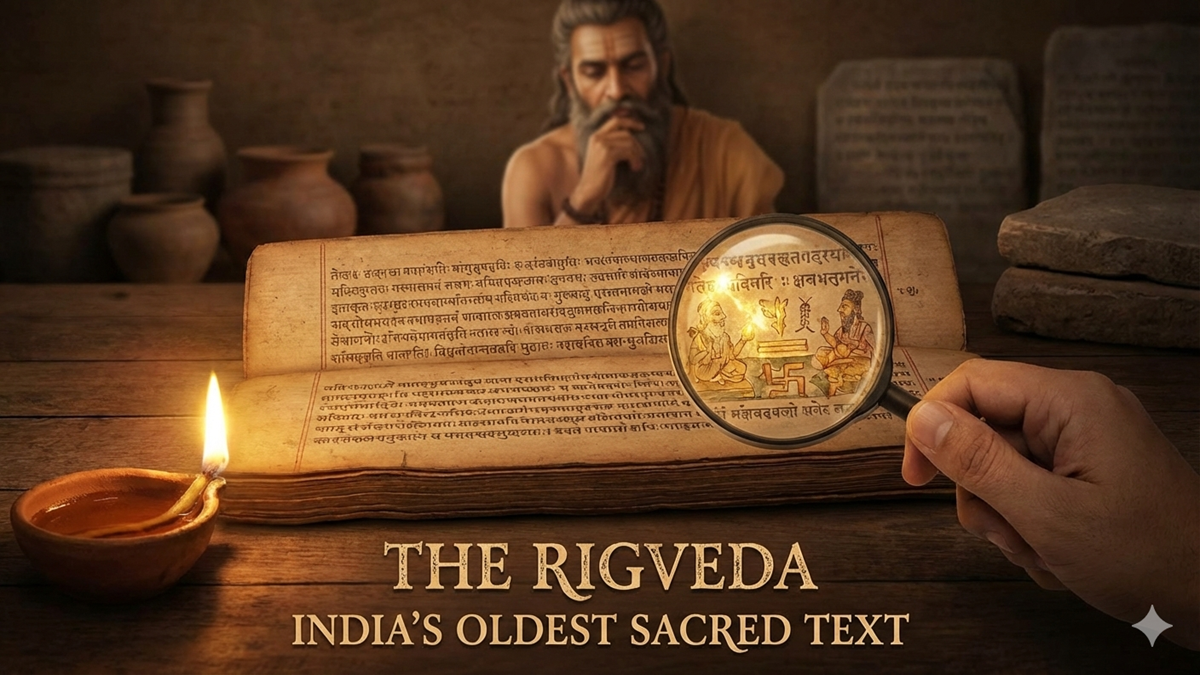

Visualize a period where no temples were adorning the skyline, no scriptures were written upon palm leaves, and kingdoms had not been established or dissolved yet. Picture the birth of humanity along the lush rivers in the beginning of mankind, where sages dwelled beneath open skies and created songs or poems dedicated to the sun, the spark of fire, the thunder of the skies, and the unknown infinity of existence.
Those hymns became the Rigveda — the oldest of the four Vedas and one of the earliest surviving literary treasures of humanity.
Nevertheless, the Rig Veda represents more than just an old sacred text; it offers insight into the very first thoughts and beliefs of individuals living in the Indian subcontinent. It shows us how previous generations looked at the world around them: natural phenomena, their communities, their ethical values, as well as their views about the universe as a whole. The Rig Veda provides us with some of the original foundations of what became known later as Sanatan Dharma, which is a living tradition characterized by inquisitiveness, appreciation for knowledge, and philosophical richness rather than a collection of fixed beliefs.
To explore the Rigveda is to journey back to the birth of Indian thought.
What Is the Rigveda?
The word ‘Rigveda’ comes from two Sanskrit words, ‘Rig,’ which means ‘praise or hymn,’ and ‘Veda,’ which means ‘knowledge.’ In this way, the Rigveda can be translated to mean ‘The Knowledge of Hymns.’
The majority of scholars believe the epic was written between 1500 and 1200 B.C.E.; however, interpretational views based on traditional Indian beliefs view the Mahabharata as being much older than this. Regardless of the debate surrounding when it was written, all agree that it is among humanity’s oldest-written works.
The Rigveda consists of:
- 10 Mandalas (books)
- 1,028 hymns (Suktas)
- Over 10,000 verses
It was composed in early Vedic Sanskrit, a form of the language that predates classical Sanskrit.
The Rigveda is considered Shruti — “that which is heard.” It is not regarded as authored in the ordinary sense; rather, the hymns were “heard” or revealed to sages in deep states of spiritual insight
The Rigveda established the philosophical basis for what became known as Sanatana Dharma, and is now referred to as Hinduism. The Rigveda, however, could not be described as a theology in the sense the term is used today by many sects. Rather, the Rigveda is a poetic expression of the natural world, as well as the cosmos and humanity.
The Miracle of Oral Preservation
Perhaps one of the greatest wonders of the Rigveda is how it survived.
These hymns have been passed down orally for thousands of years with incredible accuracy. Students learned the hymns from their teacher in a Gurukula (Gurukulam) system by repeating the entire hymn, memorizing every single sound of every word. It was necessary for each of these aspects of sounding, singing, speaking & chanting to have been learned exactly as it was to have been “taught”.
Because of all the different chanting systems used to recite Vedic texts, including Samhita patha, Padapatha, and many others, Vedic recitation meant errors could not be maintained for long periods. Each system of recitation included a backup method that would correct any mistakes made in the original system.
The oral tradition had reached such an advanced point that the original texts essentially have not altered in over 2,500 years. In some areas of India today, the same hymns are sung in the same tones as when they were originally sung in those distant lands.
The Rigveda is not just a preserved book — it is a preserved soundscape of civilization.
The Structure of the Ten Mandalas
The ten Mandalas are not uniform in theme or period of composition.
- Mandalas 2–7 are considered the oldest and are often called the “family books,” attributed to specific sage lineages.
- Mandalas 1 and 10 are later additions and contain some of the most philosophical hymns.
- Mandala 10 includes profound reflections on creation, existence, and social order.
Among the revered sages associated with Rigvedic hymns are:
- Vishvamitra
- Vasistha
These Rishis were not merely poets; they were visionaries who sought to understand the forces governing life and the cosmos.
The Gods of the Rigveda: Cosmic Forces, Not Idols
The Rigveda speaks of many deities, but they are best understood as symbolic representations of natural and cosmic principles.
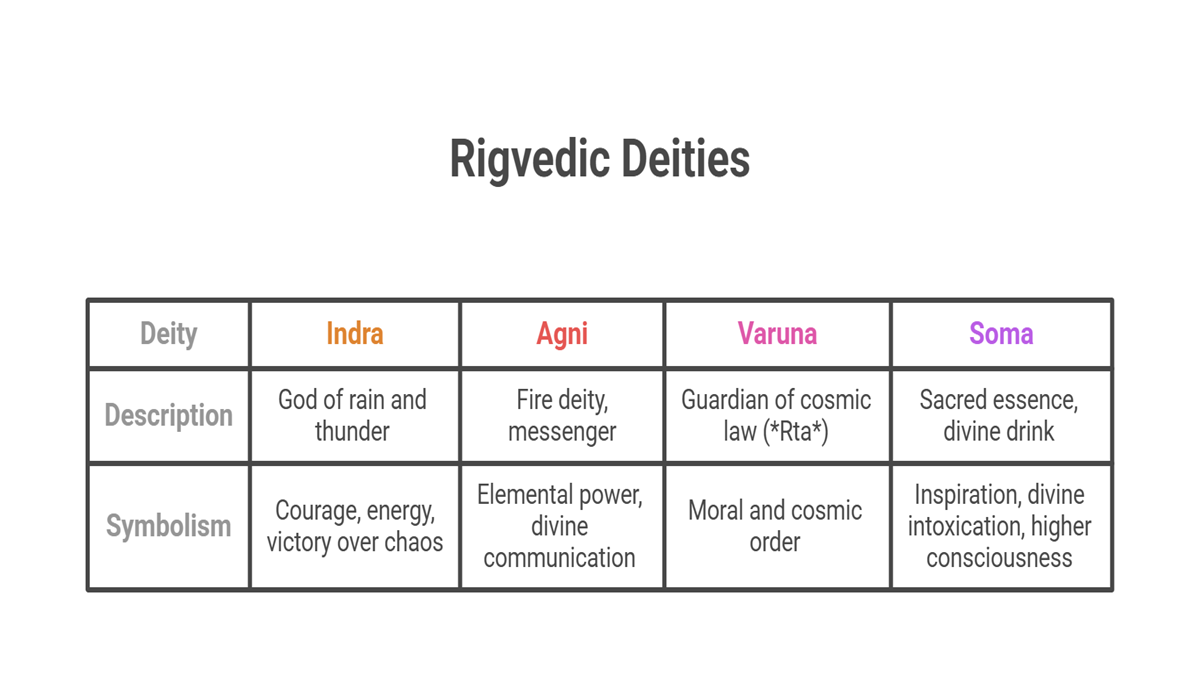
Indra – The Warrior of the Skies
In the Rigveda, Indra is widely regarded as the most popular and celebrated god. Indra is the god of rain and thunder, and is known for slaying the serpent Vritra; he is also the god who liberated the rivers from captivity, thus bringing light to earth. Symbolically, Indra represents courage, energy, and the victory of order over chaos.
Agni – The Sacred Fire
The Rigveda’s initial verse invokes Agni as a fire deity who personifies both the elemental power of fire and the divine, as well as functioning as a messenger of communication and transformation between the deities above and humankind below. With the assistance of Agni, one is able to send their offering into the higher realms (the heavens).
Varuna – Guardian of Cosmic Law
Varuna represents moral and cosmic order, known as Rta. He watches over truth and justice.
Soma – The Sacred Essence
Soma symbolizes inspiration and divine intoxication. It is said to be a divine drink that energizes gods and humans, symbolizing higher states of consciousness.
The Rigvedic philosophy was also flexible. It was common for the Rigvedic philosophy to elevate one god above the rest as the supreme god, a belief system referred to as henotheism.
The Concept of Rta: Cosmic Order
At the heart of the Rigveda lies Rta — the principle of cosmic order.
Rta, the order of nature, also defines the laws of the universe and how it functions. Rta controls such things as when the sun rises, the pattern of the seasons, how rivers flow across the land, and the ethical way that people live their lives. To live in accord with Rta is to live a life that is honest and responsible.
This concept would eventually develop into the notion of Dharma, which would influence the ethical systems of Indian civilization.
In many ways, Rta is the invisible thread that ties together the hymns, rituals, and worldview of the Rigveda.
The Nasadiya Sukta: A Universe Questioned
Among the most fascinating hymns of the Rigveda is the Nasadiya Sukta (Creation Hymn) found in Mandala 10. It begins with a startling question:
“There was neither existence nor non-existence then…”
This hymn explores the origin of the universe in a deeply philosophical and almost agnostic tone. It questions whether even the gods know how creation occurred.
Such intellectual humility reveals that the Rigveda was not dogmatic. It encouraged inquiry. It embraced mystery.
In a world often dominated by absolute mythological assertions, this humility is extraordinary. It reveals a culture comfortable with mystery — a civilization that valued inquiry as much as faith.
In a time when many ancient cultures explained creation through rigid myths, the Rigveda dared to ask — Who truly knows?
Society Reflected in the Rigveda
The Rigveda offers glimpses into early Vedic society.
Social Life
The Purusha Sūkta (Mandala 10) in the Rig Veda is a verse about the Purusha or Cosmic Being. This Cosmic Being relates to the 4 social divisions or Varnas of a society as described in the verse. It is suggested by scholars that these rigid caste structures of today were developed much later in time.
Women in the Rigveda
Remarkably, women participated in spiritual discourse. One such figure is Lopamudra, to whom hymns are attributed. Her presence suggests intellectual engagement beyond gender barriers.
Rivers and Geography
The text frequently mentions rivers, suggesting settlements along fertile regions. Among them:
- Saraswati River
- Sindhu River
These references help historians reconstruct aspects of early Vedic geography. These rivers were not just water sources; they were sacred lifelines — nourishing agriculture, trade, and settlement.
Economy
Cattle wealth, agriculture, and pastoral life were central. The society valued generosity, hospitality, and ritual participation.
Yajna: The Sacred Fire Ritual
Central to Rigvedic practice was Yajna — the sacred fire ritual.
But Yajna was not merely an offering of grains or ghee. It symbolized reciprocity. Humans offered devotion; the cosmos returned blessings.
Through Agni, communication between realms was maintained. This ritual foundation influenced later Vedic texts such as the Yajurveda and Samaveda, which expanded ritual and musical traditions.
Yajna reflects a worldview of balance — a sacred exchange between seen and unseen forces.
From Hymn to Philosophy: Influence on Later Thought
The Rig Veda helped develop the intellectual basis of the philosophical bloom of the Upaṇiṣad. The Rig Veda primarily contains hymns and puja; the Upaṇiṣads contain a much deeper exploration of the metaphysical concepts of the Self (Atman) and ultimate reality (Brahman).
Many core concepts of Indian civilization — Dharma, cosmic unity, spiritual inquiry — trace their roots to Rigvedic thought.
Its linguistic influence shaped Sanskrit literature, classical poetry, and sacred chanting traditions that continue in temples and homes today.
Modern Interpretations and Global Interest
During the 18th and 19th centuries, Western scholars began to translate and analyze the Rigveda, creating the field of Indology. Analysing this work led to many controversies over its origin, chronology, and cultural background.
Today, the Rigveda is studied not only as a religious text but as a historical and literary masterpiece. As it provides an understanding of the development of mythologies and religions and the early stages of the Indo-European language system.
For many spiritual seekers, its hymns remain sources of inspiration — not as relics of the past, but as living wisdom.
Misconceptions About the Rigveda
Myth 1: It is only about rituals.
While rituals are important, the Rigveda also contains profound philosophical reflections.
Myth 2: It rigidly enforces caste hierarchy.
The social divisions described were symbolic and evolved over time. The early Vedic world appears more fluid than later interpretations suggest.
Myth 3: It promotes blind faith.
On the contrary, hymns like the Nasadiya Sukta show intellectual openness and curiosity.
Understanding the Rigveda requires contextual reading — not projecting later social developments onto ancient texts.
Why the Rigveda Still Matters Today
In an age of environmental crisis, the Rigvedic reverence for nature feels very relevant. Rivers, fire, wind, dawn – they were all revered as sacred embodiments of the cosmic forces of nature.
The notion of living in harmony with Rta promotes ethical living and the maintenance of balance.
Most importantly, the Rigveda reminds us that Indian civilization has been built not just on temples and empires, but on thought, poetry, and reflection.
Read More Article👉: Pawapuri , The Aravalli Hills …. e.t.c
Conclusion: Listening to the First Voice of India
The real secret of the Rigveda does not lie in hidden codes or mystical exaggerations. It lies in its timeless voice — a voice that sang of fire and rain, of doubt and devotion, of order and wonder.
It is India’s oldest surviving sacred text, yet it remains astonishingly fresh in spirit. It invites us not merely to believe, but to contemplate. Not merely to worship, but to understand.
To read the Rigveda is to listen to the first whispers of Indian civilization — whispers that continue to echo across millennia, reminding us of a heritage rooted in knowledge, harmony, and sacred inquiry.



Subscribe to Our YouTube Channel: https://www.youtube.com/@BhartiSanskriti-BS