
Table of Content
Contents
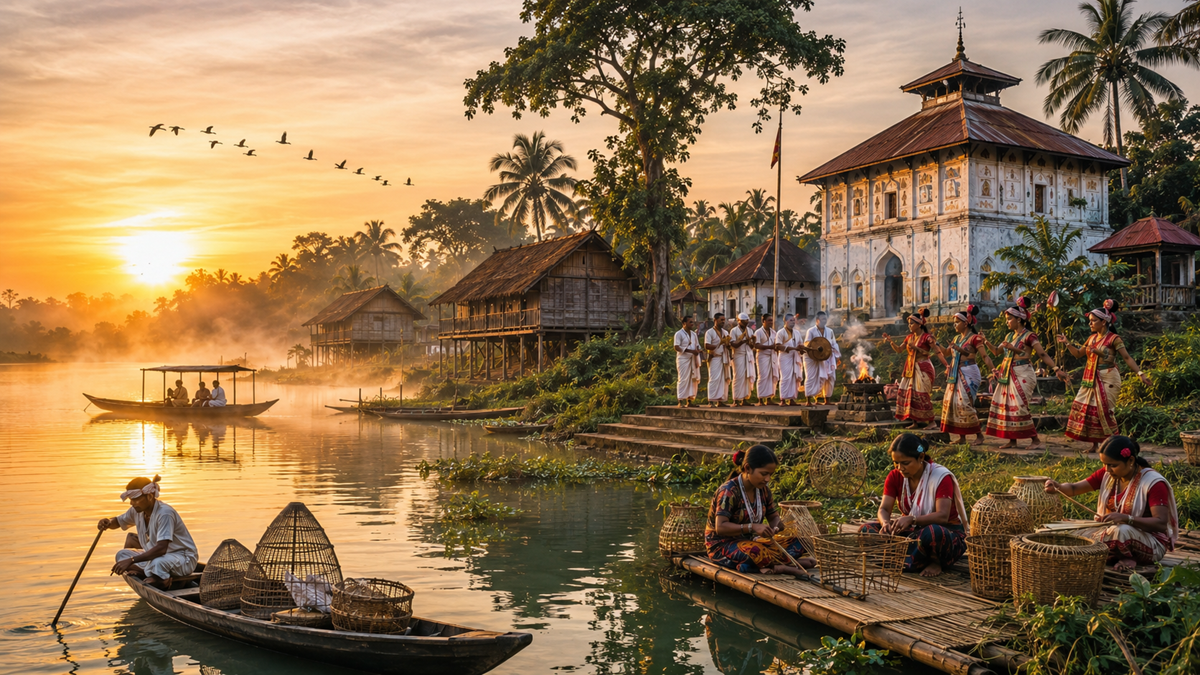
At dawn, as the first light of the sun touches the vast waters of the Brahmaputra River, a quiet transformation begins. Mist rises gently from the river’s surface, fishing boats drift silently, and distant temple bells echo across the landscape. In the middle of this ever-changing river lies a world that feels untouched by time — Majuli.
Known as the world’s largest inhabited river island, Majuli is not just a geographical wonder. It is a living, breathing cultural landscape where spirituality, art, nature, and community blend seamlessly. Here, traditions are not preserved in museums — they are lived, performed, and passed on from one generation to the next.
To visit Majuli is to step into a rhythm of life shaped by water, faith, and heritage.
A River Island Like No Other
Majuli has been created by the dynamic shifting of currents of the great Brahmaputra River and tributaries, including the Subansiri. Over centuries, the Brahmaputra has moved from one place to another and continually returned to its previous location while depositing fertile silt, causing the formation of this island (Majuli) located in the centre of the Brahmaputra River. However, the great river that created Majuli continues to change it.
This delicate balance between creation and erosion defines life here.
Wetlands, green rice paddy fields and bamboo thickets are abundant on the island, with many small communities interspersed throughout. The arrival of seasonal migration adds vibrancy to the skies, both visually and audibly. The environment is both rich and fragile, reminding us that everything in nature is both supportive of life and unpredictable at the same time.
Majuli’s geography is not just a backdrop; it is a central character in its story.
A Cultural Awakening: The Legacy of Srimanta Sankardeva
Majuli’s true identity was formed between 1400 and 1500 AD when Srimanta Sankardeva arrived on the island. He was a saint, reformer, poet and visionary who brought his faith to Majuli.
Sankardeva founded the Neo-Vaishnavism spiritual movement that embodied devotion to Krishna; worshipping simply and treating everyone equally. His goal was to bring together people of all backgrounds through faith, the arts, and culture.
Majuli became the heart of this movement.
In order to disseminate his teachings, Sankardeva developed organization known as Satras, which were monastic centers where worship and learning took place, and included activities such as art, music, and community events. The Satras changed Majuli into a lively cultural and spiritual center, which remains true to this day.
The Satras: Living Institutions of Culture
A visit to a Satra in Majuli is indeed an experience as if transported into another world where time appears to move slowly and devotion fills the air.
Among the most prominent Satras are:
- Auniati Satra
- Kamalabari Satra
- Dakhinpat Satra
Each Satra has a unique character, traditions, and expertise in art forms. Bhakats, who are monks, maintain an ascetic life revolving around worship, learning, and arts.
What truly sets the Satras apart is that they operate as unique living history museums. Manuscripts from antiquity are lovingly cared for and maintained. Daily, songs in the worship tradition are sung and passed down. The myths from mythology are told through dance and the arts.
Unlike static heritage sites, the Satras are alive — constantly evolving while remaining rooted in centuries-old traditions.
The Dance of Devotion: Sattriya and Bhaona
One of Majuli’s greatest cultural gifts to India is the classical dance form Sattriya, which originated within the Satras.
Sattriya dance tells the stories of Lord Krishna through expressive, graceful and deeply spiritual movements, facial expressions and rhythm. It was traditionally performed in monastery settings but is now recognized as one of India’s classical dances.
Bhaona, a traditional form of devotional theatre, is also incredibly fascinating. Bhaona is performed during festivals and/ or special occasions, and includes music, dialogue and elaborate costumes to tell the stories of Hindu scriptures (the Encarta dictionary defines this as “to retell [the ancient texts of the religion of Hinduism] and perform”), as retold through the performance of the play.
In Majuli, watching a performance of Bhaona is an immersive spiritual experience – it is also a form of artistic expression, or devotion, for the person performing as well as for the person watching.
The Art of Masks: Crafting Mythology
In a quiet corner of Majuli, particularly around Samaguri Satra, artisans practice a centuries-old craft that feels almost magical — mask-making.
Crafted from simple materials such as clay, bamboo, cloth and natural dyes, masks of colours, shapes, and material are created to represent various gods, demons, and other mythological figures. The masks depict both artistic talent and cultural traditions as they are shaped and painted by their creators.
While they may appear at first glance to be ornamentation only; these masks are actually an integral part of Bhaona performances; where storytelling is brought alive through visual impact.
In Majuli, mask-making is an example of artistry that combines different elements such as narrative, artistic and spiritual, into one seamlessly integrated process.
The People of Majuli: A Living Cultural Mosaic
Majuli is home to diverse communities, each contributing to its rich cultural fabric.
The Mishing Tribe
The Mishing community is one of the biggest indigenous populations found on the island. They have their way of life revolving around the rhythm of the river.
Their mode of dwelling includes stilt huts known as Chang Ghar, which can endure flooding during rainy seasons. They dress themselves in colorful attires, mainly made up of handloom products.
Celebrations, songs, and dances play a significant role in Mishing culture, and their symbiotic existence with nature holds lessons for sustainable living.
Other Communities
The Deori and Sonowal Kachari tribes are also inhabitants of Majuli Island. Though they have different cultures, they share a good feeling of unity among themselves.
Majuli is not just culturally rich — it is culturally inclusive.
Festivals: When Majuli Comes Alive
Festivals in Majuli are not just celebrations; they are expressions of collective identity and devotion.
Among the festivals that hold importance in the region, the one that is worth mentioning is the Raas Mahotsav. This festival turns the whole island into a stage wherein various incidents of Lord Krishna are portrayed in different forms of performances.
The Satras fill with music, light, and stories, which creates an entertaining atmosphere with locals and tourists, all celebrating together in an area of good spirit and energy.
The other prominent festival includes Ali Ai Ligang festival celebrated by the Mishing people and marks the beginning of farming season. It is filled with traditional dances, songs, and communal feasting.
Through these festivals, Majuli keeps its traditions vibrant and alive.
Living with Nature: A Lesson in Sustainability
Nature plays a major role in the lives of the inhabitants of Majuli. They have adapted themselves to the ever-changing conditions of the river.
The cultivation practiced here is mainly organic. The fishing is done in an environmentally friendly manner. Houses made of local materials reflect the lifestyle of people in tune with nature.
It is a refreshing change from the fast-paced urban environment where everything is artificial and alienated from nature.
A Fragile Paradise: The Struggle for Survival
Despite its beauty and cultural richness, Majuli faces a serious threat — erosion.
For decades now, the island has been reducing in size because of the strong currents of the Brahmaputra. The floods carry away soil, houses, and even whole settlements.
What is at stake is not just geography, but heritage.
Efforts are being made by the government and local communities to protect the island through embankments and conservation projects. However, the challenge remains immense.
Saving Majuli means preserving not only land but an entire way of life.
Experiencing Majuli Today
Getting to Majuli begins with crossing the Brahmaputra River on a boat, which is already an experience that prepares one for the beauty of Majuli.
Once there, time seems to slow down.
Every moment spent cycling through villages, visiting satras (community-based temples) watching artisans work, or just sitting along the river is incredibly meaningful and special. The sky during sunrise and sunset is brilliant and looks too good to be true
Majuli is not a destination for hurried tourism. It is a place to pause, reflect, and connect.
Why Majuli Matters
Majuli is more than the world’s largest river island. It is a symbol of India’s cultural resilience.
It is an extraordinary example of the harmonious union of spirituality, artistry, community, and nature. It allows for preserving traditions which otherwise could have been lost to history. It reminds us that culture is dynamic and alive.
In Majuli, heritage is not locked in the past. It flows, like the river itself.
Read More Articles 👉: Vasudhaiva Kutumbakam, India’s First Great Empire, Secrets of the Rigveda
Conclusion: An Island That Carries a Civilization
As the sun sets over Majuli and the Brahmaputra glows in shades of gold, the island seems to whisper its timeless story.
It is a tale of faith and innovation, perseverance and peace, of those who have come to terms with living amidst beauty and uncertainty.
Majuli is more than just a geographical entity. Majuli is a testimony to the very essence of Indian culture, created and nurtured by the force of its mighty rivers and vibrant traditions and the spirit of its people.
And so long as the songs are sung, the dances are performed, and the stories are told, Majuli will endure not only as the largest river island in the world but also as one of its greatest cultural treasures.
Subscribe to Our YouTube Channel: https://www.youtube.com/@BhartiSanskriti-BS/