
A City Where Stones Speak
As dawn breaks across a fantastical scene filled with massive rocks and old architecture, a wonderful experience is developing in Hampi. History fills the air, and each fallen column, every chipped sculpture speaks of what Hampi was in its earlier days – one of the largest and most impressive cities in the world.
Hampi is designated a UNESCO World Heritage Site. It has been preserved as a museum with open stones, but the significance of Hampi reaches far beyond its mere existence as an accumulation of archaic stones. The spirit of Hampi does still exist. The ancient structures’ spirits can be felt through their architecture; they continue to resonate with life through the buildings; they live on through the memories of the bygone era of the powerful Vijayanagara Empire, whose people were instrumental in shaping the grandeur that is Hampi today.
To walk through Hampi is to step into a forgotten golden age.
The Rise of a Powerful Empire
In 1336 CE, brothers Harihara I and Bukka Raya I started the Hampi story by building the Vijayanagara Empire. They founded it during a time period (when there was political unrest due to numerous invasions happening all over India), when the city-state of Hampi had been established as an important and dominant player amongst all of south India’s empires, as well as others around the world (keeping their traditions alive).
Hampi’s strategic position along the banks of the Tungabhadra River offered natural protection from invasion due to the surrounding landscape consisting of hills and rocks that surrounded the area, however there was more to its strategic position than just a military advantage; it was also a sacred place because of the many historical stories that took place here as told by the epic poem “Ramayana”.
What began as a modest kingdom soon transformed into a vast empire that stretched across South India. Its rulers were not just warriors—they were patrons of art, culture, religion, and architecture. Under their guidance, Hampi grew into a city of unmatched prosperity and beauty.
Hampi: The Capital of Splendor
At its peak, Hampi was nothing short of extraordinary. In fact, foreign travelers who visited the city were amazed by the grandeur of the place.
According to the Persian traveler Abdur Razzaq, it was one of the most magnificent cities in the world. The Portuguese traveler Domingo Paes gave a detailed account of the markets and the opulence in the city.
Picture broad roads filled with merchants offering beautiful jewels, silk, seasonings and strange products for sale. The markets were so prosperous that diamonds would be sold out in the open. This city was a destination for traders throughout the world and central to global trade.
However, wealth alone is not what characterizes Hampi; it is also an incredibly well-planned urban environment. The roads that connect temples, markets, and palaces all connect without any gaps. Many water systems are supplying the agriculture or providing water for day-to-day living. Thus, the city of Hampi represents a perfect combination of beauty and utility.
Architectural Marvels That Defy Time
Despite the ruins, the architecture of Hampi leaves tourists awestruck. This is because the buildings are not only buildings; they represent the epitome of artistry and engineering skills.
Sacred Grandeur: Temples of Hampi
Hampi’s crowning glory is the incredible temple complex known to all as the Virupaksha Temple (of Lord Shiva). This temple is one of the oldest temples still in active use today; it has been worshipped continuously and used by worshippers for centuries. The giant gopuram makes its presence felt in the landscape and acts as an orientation aid to pilgrims and travelers alike.
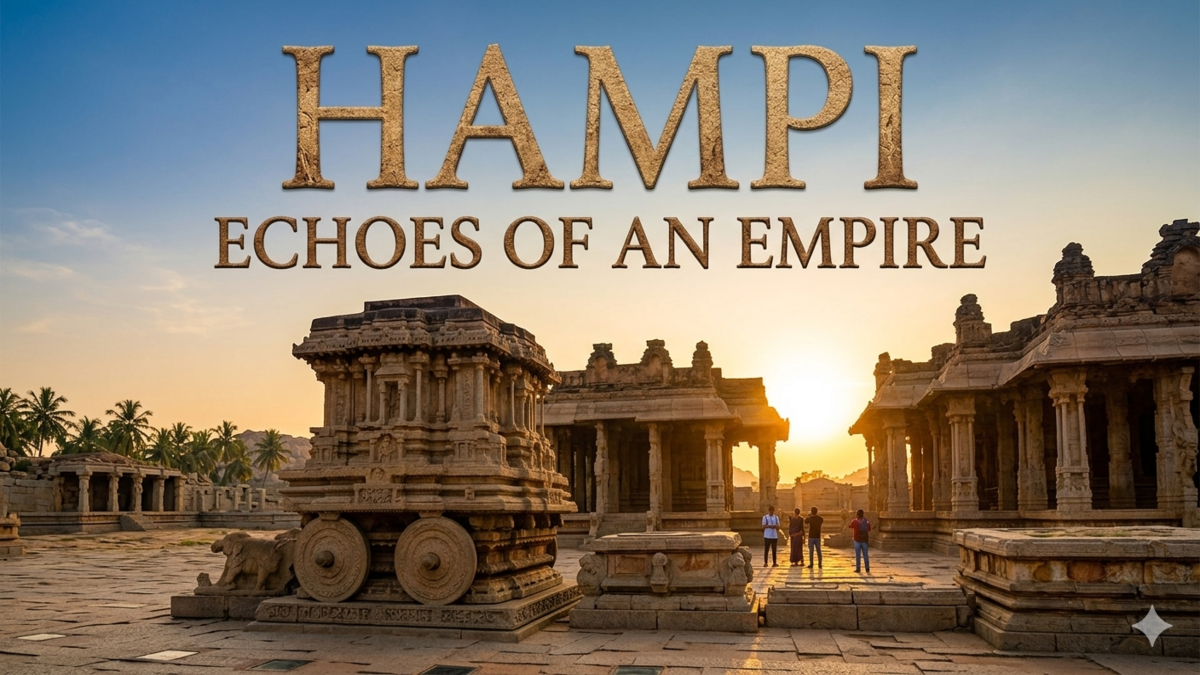
Also, there is the famous Vijayanagara architectural marvel, the Vittala Temple, which has the most famous feature: a stone chariot (or ratha) made from exquisitely carved limestone. Another astonishing feature of this temple is the musical pillars, which are said to make a different note when tapped lightly on them.
These temples are not just places of worship; they are works of art, filled with intricate carvings that depict mythology, daily life, and divine stories.
Royal Enclosure: The Seat of Power
The royal complex of Hampi reveals a different side of the empire—its administrative and royal life.
The beautiful Lotus Mahal exemplifies the Indo-Islamic architectural style through its graceful arches and symmetrical designs. Also, the nearby Elephant Stables are an example of how the rulers of the past valued their royal beasts and displayed their military power.
These buildings highlight the cultural fusion and architectural innovation that defined the Vijayanagara period.
Engineering Brilliance
The advanced water management system of Hampi is extraordinary and largely unknown. Hampi has a well-engineered network of canals, aqueducts, reservoirs, and step-wells that were developed to support both agricultural and urban development.
This reflects a deep understanding of sustainability—something that modern cities still strive to achieve.
The Golden Age of Krishnadevaraya
The real golden age of the Vijayanagara Empire was the reign of Krishnadevaraya in the early 16th century.
His reign brought about the peak of the Empire’s power, wealth, and culture. He was both a warrior and a supporter of literature and art, bringing an abundance of scholars, poets, and artists into his court.
The cities saw extensive additions to their temples; new structures were constructed; the number of citizens grew rapidly; and the overall character of the cities improved greatly, as well. The period saw remarkable growth of literature in Telugu, Kannada and Sanskrit.
Krishnadevaraya’s reign is often remembered as the golden age of Hampi—a time when the city truly dazzled the world.
Life in Hampi: A Cultural Tapestry
Hampi was more than a capital—it was a living, breathing cultural hub.
The streets were alive with festive music, dancing, and reverence during each festival of the season. In addition to worship, there was a strong focus on education and community at the temples; they provided additional services to their followers. Artisans created sculptures, textiles, and jewelry using high-quality.
Women were active participants in the cultural and social sphere – their presence in the scholar of previous generations indicates a culture that values knowledge.
Many types of people, such as traders, priests, soldiers, and artists, were all found in the cities of this area, creating a kaleidoscope of urban life in the ways they interacted with each other. Hampi was an environmentally friendly blend between spirituality and the daily activities of people living within the boundaries of Hampi.
The Fall: A Tragic Turning Point
Although they were powerful, the empire sustained a terrible loss at the Battle of Talikota in 1565.
An alliance of the Deccan Sultanates came together against Vijayanagara and defeated the empire with a decisive victory. Afterward, Hampi was sacked, laid waste, and deserted.
The great temples of Hampi suffered damage, as did the royal palaces, and a busy centre of trade was suddenly without noise.
Hampi’s decline illustrates the transitory nature of all empires, no matter how great they may be.
Why Hampi Still Echoes Its Glory
Despite centuries of ruin, Hampi continues to resonate with its glorious past.
Stones That Tell Stories
The history of Hampi is represented through the features of each building. Stories about deities, fighters, and daily activities are illustrated through the carvings that cover the walls of the temples. The size of the ruins shows us how large the city was when it had activity and functioned with a reasonable amount of energy and purpose.
Spiritual Continuity
Hampi maintains the spirit of the ancients, unlike most old ruins, as the Virupaksha Temple and the other temples still have active worship and continue to create a connection from past to present.
Some pilgrims continue to follow the path of former kings and sages.
Cultural Memory
Local legends and folklore keep the memory of Vijayanagara alive. Stories passed down through generations add layers of meaning to the ruins.
Archaeological Significance
Ongoing excavations continue to reveal new insights into the city’s past. Each discovery adds another piece to the puzzle of Hampi’s grandeur.
Hampi Today: A Journey Through Time
Visiting Hampi today is not just a trip—it is an experience.
You can almost feel like you’ve been transported back in time while walking through the ruins. The dramatic boulders of the landscape accentuate Hampi’s surreal feel.
The sunrise and sunset are magical, as they illuminate the stone temples with warm, golden memories of history.
Hampi is an invaluable experience for tourists, historians, and devotees of spirituality because it is an opportunity to connect with history on an intimate level.
Lessons from Hampi’s Rise and Fall
Hampi teaches us timeless lessons:
- Even the greatest empires are not permanent
- Cultural heritage must be preserved with care
- True strength lies not just in power, but in creativity and wisdom
- Harmony between nature, architecture, and spirituality creates lasting beauty
Explore More👉: Bihari Cuisines, The Real Story Behind the Iron Pillar of Delhi …. etc
The Eternal Echo of an Empire
The ruins of Hampi may be silent, but they are far from lifeless. They echo with the footsteps of kings, the chants of priests, the laughter of markets, and the dreams of an empire that once stood at the pinnacle of power and culture.
The glory of the Vijayanagara Empire has not faded—it lives on in every carved stone, every towering pillar, every sacred space.
Hampi reminds us that history is not just something we read—it is something we can feel, experience, and carry forward.
And as long as these stones stand, the echo of Vijayanagara will never truly fade.





Subscribe to Our YouTube Channel: https://www.youtube.com/@BhartiSanskriti-BS