
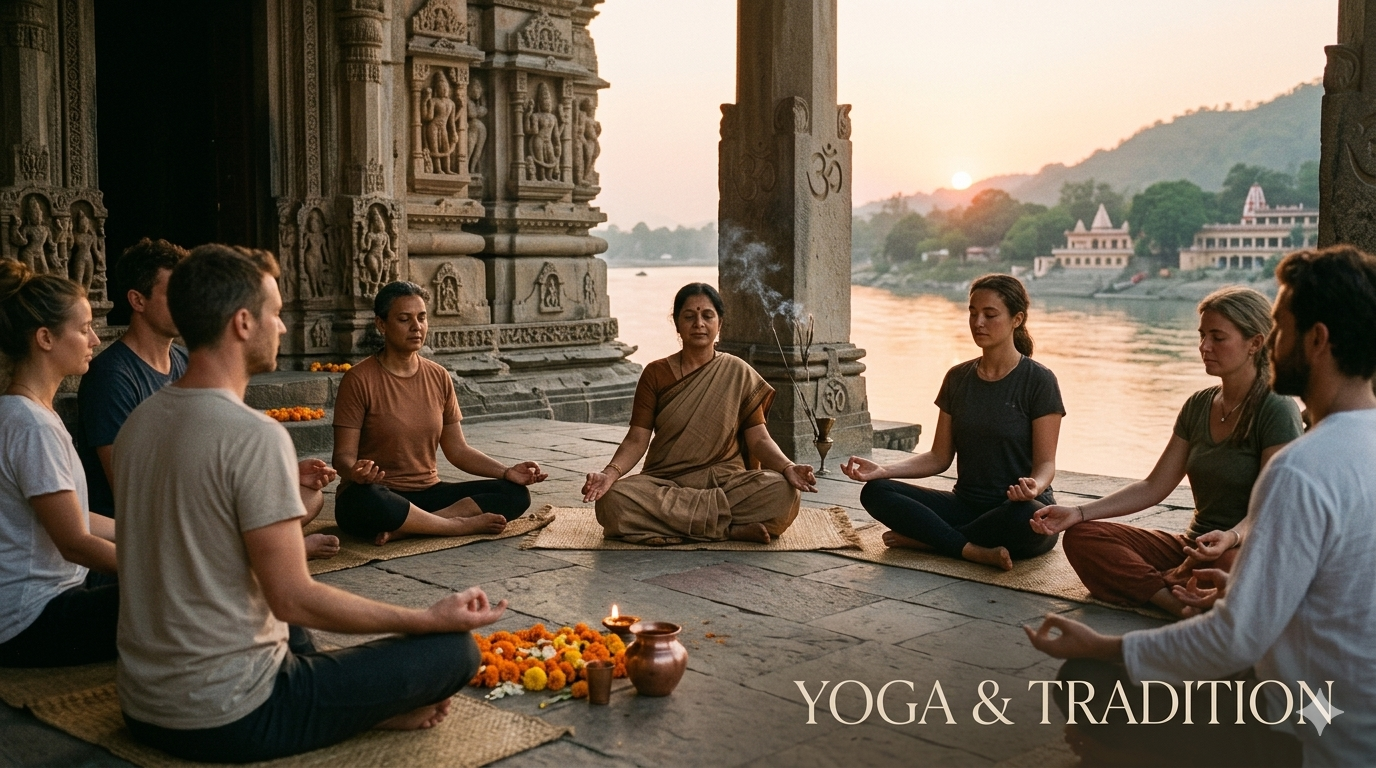

Today, many people associate yoga with the practice of sun salutation sequences, poses online for people to copy, or videos to demonstrate how to become more flexible and relieve stress. These are all real aspects of yoga in its current state and have been widely adopted for their appeal and usefulness. They are only a part of what yoga is on a much larger scale. When looking at it from an overall perspective, yoga is actually a major cultural technological innovation, i.e., it is a set of practices and guidelines for how to do those practices and how to perceive oneself as part of the universe. It gives people a framework (i.e., a path) by which to align their body, mind, and actions and, in doing so, provides them with a guide for how to think about and find meaning in their lives, for how to have relationships with others, and ultimately for how to live their lives.
In this article, we will explore the cultural significance of yoga in India over thousands of years, going beyond the common media representation of asanas (the physical postures). Our starting point will be the language that describes yoga, its references in ancient scriptures, its moral principles, its place alongside the other sciences of India, as well as how it has evolved into a global symbol of culture and a source of dispute. By studying these three areas, we hope to present a case for why the study of yoga is significant both culturally and physically.
What “yoga” really means: union, not just movement
The English word “yoga” has its origins in Sanskrit, deriving from the root word yuj, which means to join or yoke two things together. This gives us some insight into yoga’s ultimate purpose — it is meant to unite people or things. So what is it that is being united?
- The body and the mind — so breath, posture, and attention no longer work at cross purposes.
- The individual self and a broader sense of awareness — turning action from compulsive reaction into conscious choice.
- Practical life and inner clarity — so ethical behavior flows naturally from a settled mind.
When viewed this way, posture work (Asana) is beneficial but indirect – developing the body as a vehicle for steady sitting, breathing, and mindful attentiveness. The core teachings of Yoga are found in the practices that teach individuals to develop their ability to create mindful and intentional habits of attention, empathy, and control.
Yoga in the Scriptures and Classical Texts
The ideas of yoga are threaded throughout the intellectual history of India, pre-dating modern studio culture. Three texts are particularly significant.
Yoga in Early Scriptures
Early meditative and philosophical traces of yoga can be found in both the Vedas and the Upanishads through the practices described as turning inward, developing attention, and discovering the self. Furthermore, these texts show that meditation is a way to explore consciousness and ethics.
Bhagavad Gita and the Yoga of Action
The Bhagavad Gita does not present yoga solely as renouncing the physical world, rather it represents a way in which to act within that realm. The Gita identifies different ways that individuals may practice or perform their duty — action (karma), devotion (bhakti), and knowledge (jnana) to transform the way we live. One of the main characteristics of all these differing ways to practice is the focus on performing one’s duty without attachment to the results of those actions. As such, this concept makes yoga relevant for both those who live in the world (householders and workers) as well as for those who do not (ascetics).
Patanjali and the Yoga Sutras
Patanjali wrote the Yoga Sutras that codified the classical approach to yoga into a systematic framework; the Eightfold Path, or Ashtanga, provides a cultural structure for ethics (Yama and Niyama), asana (postures), pranayama (breath), pratyahara (sense withdrawal), dharana (concentration), dhyana (meditation), and samadhi (the experience of being fully absorbed in an object). It is clear from this hierarchy of development of practices that the basis of posture is the formation of our moral self.
The Eight Limbs: An Ethical Blueprint for Life
Patanjali’s eight limbs are not merely sequential technical steps; they form a cultural grammar for living:
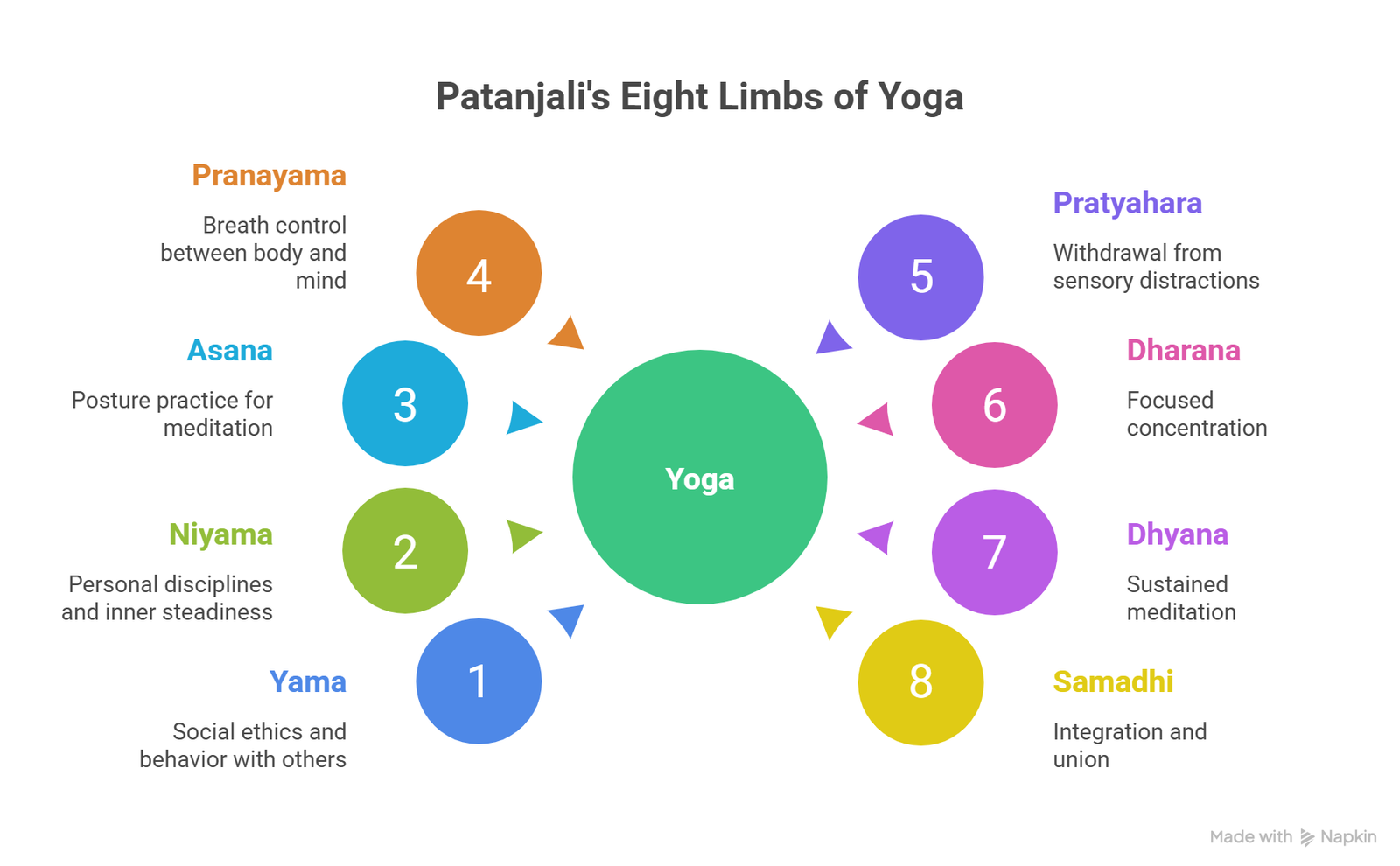
- Yama — social ethics (non-violence, truthfulness, non-stealing, moderation, non-hoarding). These guide how one behaves with others.
- Niyama — personal disciplines (cleanliness, contentment, austerity, study, surrender). These cultivate inner steadiness.
- Asana — posture practice, originally to steady the body for long meditation.
- Pranayama — breath control; the bridge between body and mind.
- Pratyahara — withdrawal from sensory distraction; turning attention inward.
- Dharana — focused concentration.
- Dhyana — sustained meditation.
- Samadhi — integration or union; a state where the distinction between knower, known, and knowing softens.
Yoga’s concept of limb serves as an example of how yoga aims to develop one’s character (yama/niyama), create balance within one’s systems (asana/pranayama), and develop focused concentration (dharana/dhyana) through a variety of means. The yoga studio’s postural practice is merely one item among many, as there are numerous other methods within the civic toolkit to achieve similar outcomes.
Yoga as a Way of Life in Indian Culture
In traditional Indian culture, yoga was not an isolated physical activity found only in the gym. It was an integral part of an interrelated cultural system.
- Gurukul and teacher-student relationships. Learning was an intensely personal relationship between mentor and disciple.
- Connection with Ayurveda. The concern with balance—of doshas, breath, and digestion—links yoga and Ayurveda. Both emphasize the importance of prevention and lifestyle.
- The arts and performance. Classical dance and music employ yogic techniques of focus and breath control. Temple sculpture often commemorates meditation postures, indicating a cultural link between aesthetics, spirituality, and physicality.
- Ritual and daily discipline. Daily activities—breathing techniques, sun-worshipping prayers, seasonal celebrations—can be seen as the practical applications of yoga.
Seen as a civilizational practice, yoga shaped not just personal health but social habits — patience in work, moderation in appetite, and an orientation toward duty and balance.
The Idea of Samatva: Balance at the Heart of Yoga
Samathva — equanimity — is part of the central ethical thread of Yoga. The Bhagavad Gita urges: “yogastha kuru karmani” — to act while being established in yoga. This does not mean to act passively. Rather, it means to develop a mind that will not be shaken by success or failure.
The relationship between samatva and resiliency can be seen in many ways — from family pressures, to the unpredictability of one’s ability to make a living or even the moral dilemmas of life, through to developing the skill of paying attention steadily without reacting and thus being able to respond wisely. The modern-day equivalent of samatva is providing a framework of understanding for how to manage stress and clarify what is right and wrong.
Yoga Beyond Religion: Why it Travels
Yoga’s deep connections to Indian spirituality do not limit its central principles to any particular tradition or belief system. Activities designed to bring peace to the mind, give control over one’s breath, and build focus all have appeal around the world. This globally accepted nature of yoga is evidenced by two factors.
Global uptake. Individuals of various religious and ethnic backgrounds practice yoga for mental health, sports, or spirituality.
Adaptability. Teachers may teach yoga as a practice of mindfulness, a therapeutic practice, or a philosophy, each of which maintains a different focus but retains the essence of increased self-control and awareness.
This versatility is the strength of yoga, which has led to its popularity, as well as the weakness of yoga, which has given rise to the question of yoga’s dilution.
International Recognition and Modern Debates
In the past few decades, Yoga has gained tremendous international recognition, as demonstrated by the establishment of an annual event known as International Day of Yoga (21 Jun). This has resulted in significant amounts of cultural exportation through large gatherings and public demonstrations as examples of “soft cultural diplomacy.”
With global reach, however, comes questions: Is presenting yoga chiefly as exercise a misrepresentation? Has commodification hollowed out its ethical aims? How should cultural custodians respond when yoga is repackaged as purely aesthetic or commercial?
Healthy answers recognize both: Modern practices serve as portals for most people, while ancient or traditional teachings and collective forms of supporting institutions offer a foundation for deeper understandings. To create value in the connection of two worlds, one must provide a respectful, interpretable means of connection; e.g., by establishing an ethical framework for teaching breath practices, or pairing posture classes with teachings regarding mindfulness and compassion.
Common Misconceptions and Clarifications
There are several misconceptions about yoga. Below are brief correctives you can use in outreach or writing:
- Yoga is not a religion. It has religious roots and overlaps with spiritual practices, but its techniques can be used secularly.
- Yoga is more than exercise. Asana matters, but so do ethics, breath, and attention.
- Yoga is not only for the young and flexible. The practices scale; many people benefit from subtle breath and attention work, even if their bodies are limited.
- Traditional yoga emphasizes community and teacher guidance. Self-study is valuable, but lineage and mentorship historically played a central role.
These clarifications help readers approach yoga with humility and curiosity rather than quick assumptions.
Yoga in Contemporary Indian Identity
In India today, yoga occupies multiple cultural roles simultaneously:
- A daily practice for many urban professionals seeking mental calm amid fast lives.
- A revival and pride marker for those reconnecting with cultural roots.
- A commercial industry of studios, certifications, retreats, and apparel — with both genuine value and risks of commodification.
- A therapeutic adjunct in hospitals and schools, where breath and movement practices support mental health and rehabilitation.
In our current age of pluralism, the question becomes, “How can we create an environment that promotes accessibility while still providing opportunities for depth?” One way to accomplish this is through layered instruction by providing both accessible entry-level classes and areas dedicated to deeper level studies, such as ethics, breathwork, and meditation.
Why Yoga Still Matters — For Individuals and Societies
Yoga’s survival and spread suggest it meets real human needs. Practically, it supports:
- Emotional regulation and stress resilience.
- Improved attention and cognitive control.
- Social cohesion is practiced in groups with shared values.
- A framework for ethical living that connects interior discipline to outward action.
From a cultural perspective, the philosophy of Yoga suggests that one’s human being is a set of systems: a Body (made up of organs and tissue, etc.), a Breath (that provides oxygen and energy), and a Mind (that generates thought processes). Informed by disciplined, repeated activities, these systems can be developed into healthy, functional beings. This way of understanding the person as a whole continues to be a valuable resource for today’s society as they deal with anxiety, distractions, and issues related to our environment.
Practical takeaways for Respectful, Deeper Practice
If you want to adopt yoga beyond the fitness frame, try these simple pivots:
- Learn the ethical starting points. Even reading short notes on yama and niyama gives context to posture practice.
- Prioritize breath and attention. Start or end a class with pranayama and a minute of silent noticing.
- Find a teacher who values both technique and ethics. Ask about lineage or how they integrate meditation and moral reflection.
- Use yoga to connect, not only to perform. Practice with family or a group to access its social benefits.
These small shifts can transform yoga from an isolated workout into a sustained tool for character and community.
Explore More👉: Secrets of the Rigveda, Sonepur Mela, Evolution of Indian Scripts, National Emblem Of India
Conclusion: A Living Cultural Offering
Yoga dates back thousands of years but remains very relevant today; the many physical benefits of yoga include increased flexibility, improved focus, and reduced stress; however, the ethical principles taught through yoga also guide how we treat others. The cultural bridge aspect of yoga can be established when it is taught or practiced in an environment where there is a genuine intent to honour others and to adapt traditions to individual circumstances, thus providing each individual with tools or guidance for self-care as well as demonstrating an ethical way to be a compassionate person, be balanced and have a constant focus (or attention) on personal development.
When we consider yoga as a mere exportable brand, the majority of what contributed to its long-lasting appeal is lost. However, utilizing its current popularity as a gateway for introduction to breath, ethics, and attention gives us a means for continuing this ancient gift of yoga – a series of practices that support the cultivation of steadiness, dignity, and connectedness in a world where these qualities are in great demand.



Subscribe to Our YouTube Channel: https://www.youtube.com/@BhartiSanskriti-BS