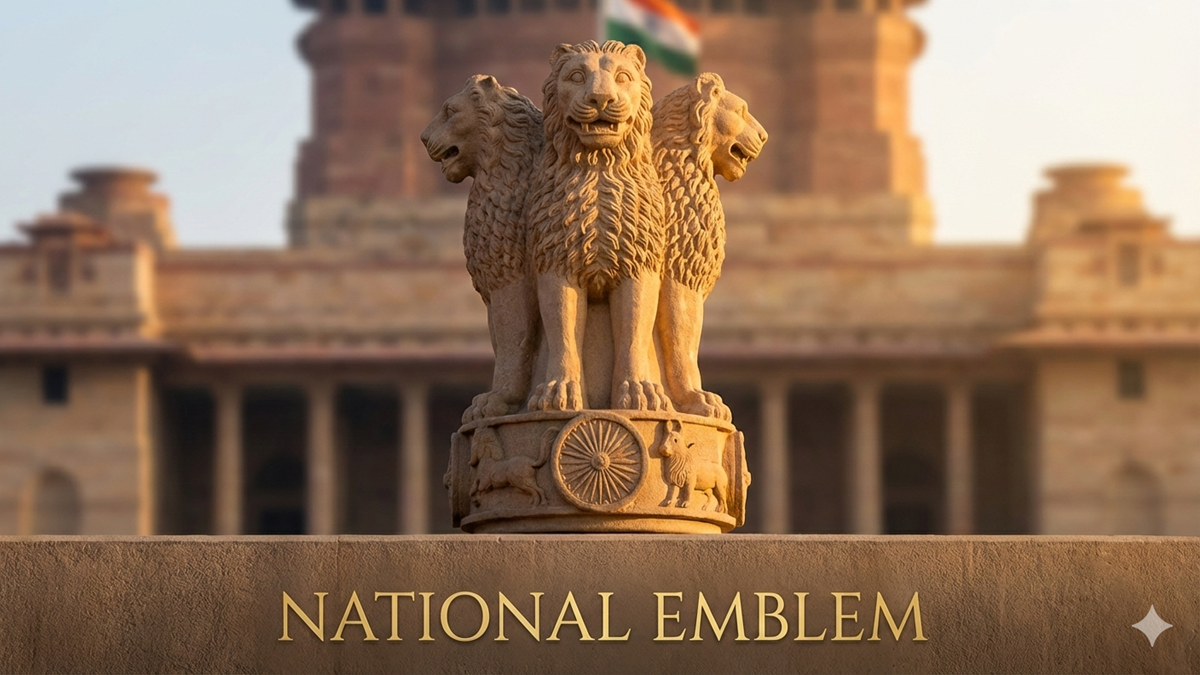

As a nation’s representative culture in artistic expression, the national emblem gives an idea about who the country is, its culture, and how the country sees itself. The emblem chosen at independence for India was not a created design but rather an ancient work of art. It is actually the Lion Capital introduced by Emperor Ashoka during the 3rd Century BCE. On top of the capital, you will find the 4 lions on all 4 corners of the capital; to the right of each lion will be a wheel that was associated with Indian culture. The word सत्यमेव जयते (Satyameva Jayate) — “Truth Alone Triumphs” is inscribed on the capital. The design of the capital contains the political philosophy, ethical values, and artistic creation of India spanning a time period of thousands of years into one image. This article will examine the background, characteristics, symbols, and importance of how the capital of Ashoka will play a role in shaping the government of India, as well as Indian society today.
A Symbol That Defines a Nation
Symbols anchor nations. Flags, anthems, and emblems represent nations in both the emotional and intellectual realms; they are tangible representations that reiterate otherwise abstract concepts. The National Emblem of India performs this dual purpose of linking the current Republic of India with its historical roots (the Maurya Dynasty), while also representing the ethical foundations of modern Indian society (Dharma, Truth, Justice). India’s National Emblem is used on currency, official documents, official government buildings, and passports. This functions as a graphical representation of both authority and national identity.
What Is the National Emblem of India?
The national emblem is a stylized rendering of the Lion Capital erected by Emperor Ashoka at Sarnath. The principal elements are:
- Four Asiatic lions arranged back-to-back in a circular abacus (in two-dimensional form, three can be seen).
- A circular abacus with four animals – an elephant, a horse, a bull, and a lion, separated by Dharma Chakras (Wheels).
- The Ashoka Chakra, the wheel of law, which also appears in the centre of the Indian national flag.
- A lotus base on the original sculpture (the official state emblem leaves out the full lotus), and the national motto सत्यमेव जयते (Satyameva Jayate), derived from the Mundaka Upanishad, is inscribed below the abacus in Devanagari script.
As per the government-approved method of reproduction, only the upper part of the capital is used, excluding the lotus-shaped base; the phrase that signifies the state is often presented directly below the abacus. The emblem serves two purposes in this sense: one being an archaeological artifact, and another being an indicator that the object is representative of a country’s national sovereignty.
Historical Origin: The Lion Capital of Ashoka
The Lion Capital was sculpted by the Emperor Ashoka (c. 3rd century BCE), a major individual in South Asian history. Ashoka, following his deep regret over the Kalinga war, adopted and promoted a code of morality and administration called dhamma (dharma); he placed pillars and edicts throughout his empire in order to spread the message of dhamma. The capital located at Sarnath, where the Buddha is believed to have preached his very first sermon, represents one of the most sophisticated artistic accomplishments of the Mauryan era.
The polished surface of the sculpture—its proportions and the programmatic symbolism—are meant to communicate political authority (emperor-like) and religious canonicity (god-like) through an articulation of moral authority through “the lion” as well as the wheel and the animals within the “Abacus.” The lion, the wheel, and the animals of the abacus represent moral and spiritual authority while also expressing dynamism associated with godly governance and moral sovereignty. Following the establishment of the Indian Republic in 1950, the Lion Capital became the official State Emblem of the Republic of India, thereby linking today’s constitutionally established Indian Republic to the ancient notion of righteousness in action.
Architectural and Artistic Features
The Lion Capital is an elegant piece of stone carving:
- Material and finish: It is carved from a single block of polished sandstone, demonstrating the Mauryan mastery of stone polishing and large-scale sculpture.
- Composition: Four lions sit on a circular abacus with their backs against each other. Below the abacus is a bell-shaped lotus. The abacus has high-relief animal representations and depictions of the Dharma Chakra. The posture of the lions, which is alert and proud with an outward gaze, shows both realism and idealization in form.
- Two- and three-dimensional representation: In the museum or on currency, the capital is often rendered in profile or as a flattened image; the full three-dimensional work allows all four lions to be seen simultaneously atop the pillar.
These features show that the Lion Capital was conceived as both a monumental sculpture for a public site and a codified emblem of moral authority.
Symbolism and Meaning
What gives significance to the emblem is its complex significance. The Lion Capital of Ashoka can be interpreted on various planes, ranging from politics to spiritual iconography to art.
The Four Lions
The power, courage, pride, and confidence of the lions that are back-to-back on the edges of the emblem represent these qualities as well. The Lions are facing four directions and represent the idea that the sovereign’s power or the rule of dharma exists in every part of the universe. The Lions also function in many interpretations as guardians of the moral order and are used in a visual way to signify that just governance is not only aware of but vigilant about wherever there is dharma, in every place there is just governance.
The Abacus Animals
Animals are carved into relief on the circular abacus. There is an elephant, a horse, a bull, and a lion – these animals are separated by the Dharma Chakra, known as the Wheel of Law. Traditionally, the animals have been interpreted as symbolic of either the different stages of the life of Buddha or the various aspects of human life. They may also be seen as symbols of Power (or Strength – Elephant), Speed (or Energy – Horse), Work (or Stability – Bull), and Courage (or Strength) – Lion, with the four attributes illustrating a balanced political structure in which the values of the animals work together for the benefit of the society.
The Ashoka Chakra
The Dharma Chakra (or Wheel of Dharma) represents righteous law and the concept of perpetual motion. The spokes of the wheel also indicate that ‘Dharma’ must be engaged on a daily basis; in modern-day India, the 24 spokes of this ‘Ashoka Chakra’ serve as both an emblem at the center of India’s National Flag, establishing the connection between these symbols along with the nation’s moral guidelines.
Satyameva Jayate
The motto of the emblem, “Satyameva Jayate” (which means “Truth Alone Triumphs”), is taken from the Mundaka Upanishad, and it represents the basis of the ethical values of the State. The motto provides legitimacy to the State on the basis of its authority established through the tenets of Truth, Justice, and Morality.
Adoption as India’s National Emblem
The Lion Capital was chosen by the Constituent Assembly as the State Emblem for the newly independent and democratic nation of India on January 26, 1950. It was chosen for its connection to India’s ancient history of moral leadership and philosophical depth, as well as for its classical Indian origin (the Lion Capital is a sculptor’s work done around 250 BCE). In choosing the Lion Capital, the Assembly sought to create an emblem for the new Republic that reflected continuity with India’s past while also conveying messages about the values upon which the Republic is founded — that is, the emphasis placed on truth and law.
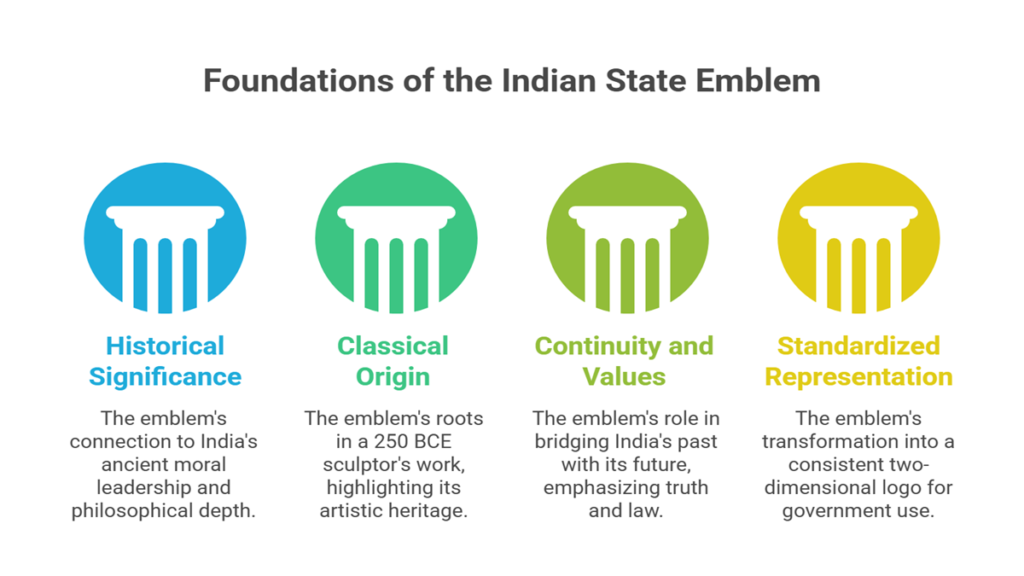
The reproductions basically represented a standardisation of the ‘design’ in that they were all made in a two-dimensional image of ‘three-lion’ (and one lion hidden behind), with abacus animals and wheels on top, and the phrase ‘Satyameva Jayate’ under it. Thus, the reproduction became a symbolic representation, not only of a historical archaeological finding, but also as the functional logo of the Indian Government.
The Emblem in Modern India
The emblem’s presence is ubiquitous in the official life of India:
- Currency and coins: It appears on banknotes and coins as a mark of the state.
- Official documents: Government orders, gazettes, passports, and certificates carry the emblem.
- Public buildings and seals: Courtrooms, ministries, and official seals display it as a sign of legitimate authority.
- Uniforms and insignia: Many branches of the civil service and law enforcement incorporate the emblem into badges and insignia.
Since the emblem serves as an official state seal, there are regulations about how it may be used. This prohibits misuse and maintains the prestige of the emblem; where this type of use has been permitted, it has generally been limited to non-commercial and legitimate uses.
Legal Protection and Respect
The Parliament of India has enacted rules and laws to preserve the dignity of the State Emblem and restrict its misuse. These rules define the persons permitted to use the State Emblem and limit the places they can be used. They also impose penalties for using the State Emblem without authority or in a manner that could be interpreted as disrespectful to the emblem and that represents the identity of the nation as an emblem of the nation — not as a commercial logo — and clarifies that state emblems are symbols of civic authority and have a certain authority in law.
To stop people from misusing it, the Government made two important laws:

The State Emblem of India (Prohibition of Improper Use) Act, 2005
This Act prohibits the improper use of the National Emblem for professional, commercial, or personal purposes. It ensures that the emblem is not used in a way that:
- Disrespects or lowers the dignity of the State
- Misleads people into thinking a person or organization is officially connected with the government.
- Exploits the emblem for advertising, business, or political gain
Any unauthorized or distorted use of the emblem is punishable with fines or legal action.
The State Emblem of India (Regulation of Use) Rules, 2007
These Rules define who can use the National Emblem and how it can be used. They clearly specify:
- Which authorities, officials, and institutions may display the emblem
- The correct design, proportion, and format
- Where and how the emblem may appear (documents, buildings, seals, vehicles, etc.)
Only constitutional authorities, government offices, courts, and authorized bodies may use the emblem officially. Private individuals and organizations are not allowed to use it without explicit permission.
Spiritual and Cultural Dimensions
The Lion Capital is not merely a symbol of political power; it transcends that, for it has both spiritual and cultural significance. Ashoka’s ties to Buddhism and his attempt to teach right conduct through moral governance have created a powerful legacy that connects the Lion Capital to both the spiritual significance of non-violence and moral duty and the importance of serving the public good. The phrase “Satyameva Jayate” (Truth alone triumphs) embodies the wisdom found in the Upanishads (ancient Hindu scriptures) and links this emblem to the broader Indian way of thinking about truth (Satya) as the foundation of duty (Dharma).
Citizens use the emblem as a reminder of what is expected of them in terms of governance, as well as a historical link to the grandeur of ancient India. The emblem also describes their hopes for nationhood.
Comparison with Other National Symbols
Unlike the national flag and the national anthem, which serve certain social functions, India’s national emblem has a unique role in society. The national flag is the collective social identity; it is displayed on all types of ceremonial and civic occasions. The national anthem serves as a ritualistic sound of national unity. The national emblem serves as the legal and executive seal or stamp of the federal government, as well as for any agency or department of the federal government; it is also a symbol of legal authority and constitutional legitimacy for each of these entities. In this way, the national emblem is a distinct representation of India’s sovereignty, which is to be exercised in accordance with India’s laws and also in accordance with moral principles.
Read More about India’s National Symbols: National Flag, National Anthem, National Bird …. e.t.c.
The Emblem as a Living Legacy
The Lion Capital’s symbolism will live on, as each succeeding generation will add its own interpretation based on what they interpret its meaning to be. Historically, the Lion Capital has been appreciated for its fine artistry, but the Lion Capital continues to be relevant in the processing of governmental, societal, or public communication by addressing matters of duty. The emblem serves as an inspiration for students, judges, and government officials. The emblem serves as a reminder to citizens and leaders, in all walks of life, of the responsibilities they have to themselves as well as to their fellow citizens.
More Than a Symbol
The Lion Capital of Ashoka, India’s National Emblem, can be described as compressed yet capacious. It fuses the art of imperialism and the principles of republicanism; it embodies both Buddhism’s philosophical inspiration and Upanishadic wisdom; it reflects both aesthetic sophistication and civic responsibility. As India continues to develop into the future, so too will the Lion Capital represent a constant source of direction. It serves as an opportunity to bring together principle and power, to bring together governance and verity, and to bring together pride and accountability between all Indian citizens and their leaders. The Lion Capital represents not only a static representation of the ideals that are embodied within it, but also an ongoing articulation of the challenge that is associated with translating the Lion Capital’s principles into the existence of all public life.




Subscribe to our YouTube Channel: https://www.youtube.com/@BhartiSanskriti-BS